
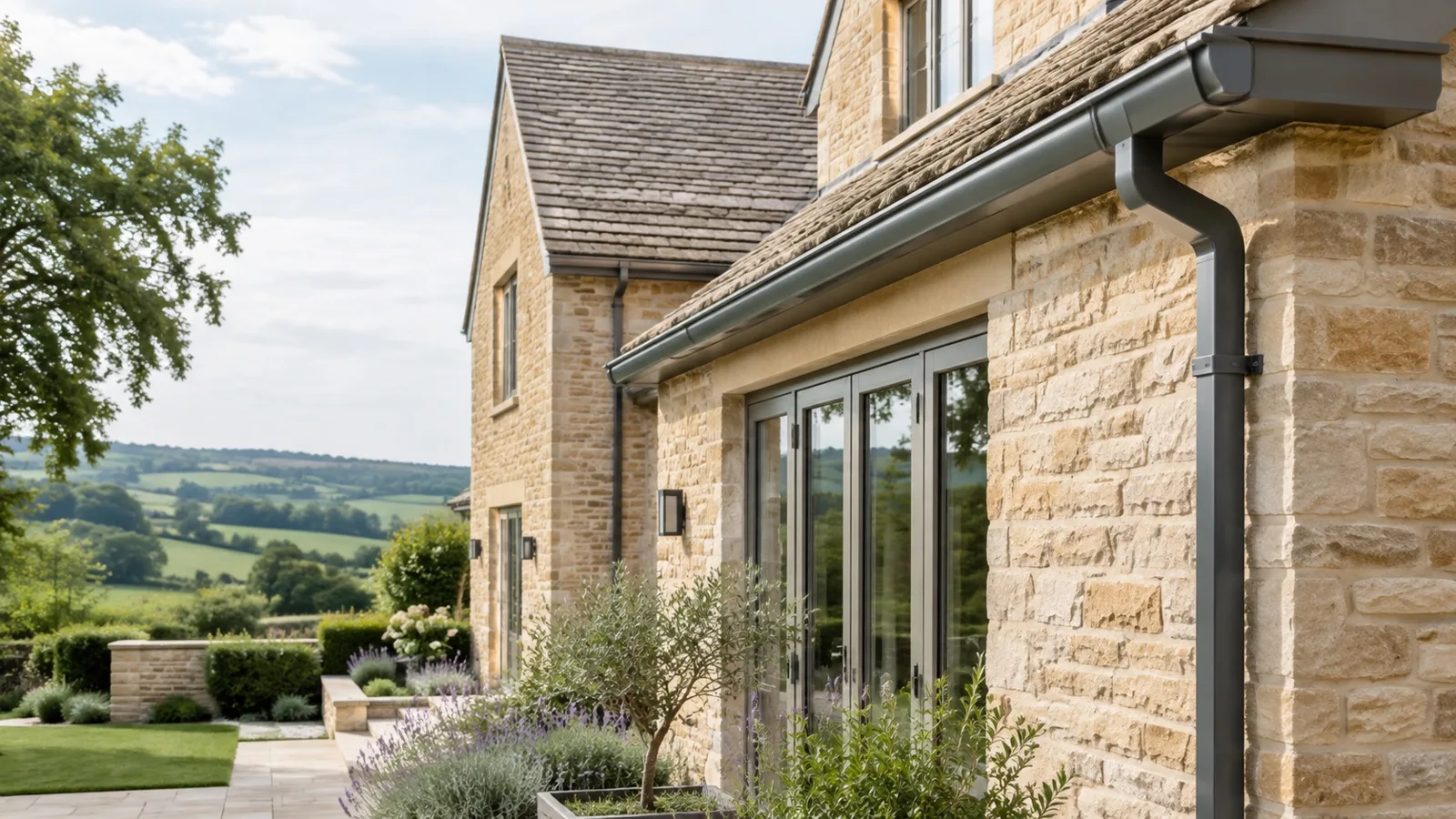
There is a familiar soundtrack to autumn and winter across the English countryside: the steady patter of rain against the windowpane, accompanied all too often by the rhythmic, irritating drip of a leaking gutter joint. For decades, standard sectional plastic systems have been the default choice for domestic housing, yet their vulnerabilities are well known. Rubber gaskets perish under UV light, seasonal temperature swings cause joints to warp and pull apart, and before long, water is cascading down external masonry or pooling around foundations.
For homeowners seeking a permanent, elegant resolution to these perennial headaches, seamless aluminium guttering has quietly established itself as the most sensible, high-performance investment available.
Continuous lines, zero weak points
To understand the enduring appeal of seamless aluminium, one only needs to look at how it is created. Unlike sectional guttering, which arrives in short lengths and relies on repeated joins every few metres, a seamless system is roll-formed directly outside your home from a specialist mobile workshop.
Coiled aluminium sheet is passed through precision tooling mounted inside our vehicle, extruding continuous, bespoke lengths tailored to the exact dimensions of your roofline. A single run can easily span twenty metres or more without a single mid-point seam. By eliminating joints along the run, you eliminate the very points where silt accumulates, moss takes root, and leaks inevitably develop.
The resulting profile is clean, architectural, and structurally continuous. Corner mitres and downpipe outlets are carefully sealed using high-grade, long-curing polymer sealants, but the vulnerable spans that bear the brunt of heavy English cloudbursts remain unbroken.
Built to endure unpredictable British weather
Rainfall in our corner of the country is becoming noticeably more intense. Short, torrential downpours test rainwater systems in ways gentle drizzle never could, and standard half-round gutters often struggle with capacity. Seamless aluminium gutters are typically formed in an ogee profile—a classic, gently curved shape that not only looks purposeful and refined against both modern render and traditional red brick, but also holds significantly more water than conventional plastic alternatives.
Beyond capacity, the material itself offers exceptional longevity. Extruded from marine-grade alloys, aluminium naturally forms a protective oxide layer that resists corrosion. Finished with a tough, factory-applied polyester powder coating, the system will not crack, bleach in direct sunlight, or turn brittle in a hard frost. While plastic gutters look tired after less than a decade, a properly installed aluminium system routinely delivers upwards of thirty trouble-free years.
The practical advantages for everyday households
When we talk to clients across Oxfordshire, Wiltshire, and Berkshire, the conversation often begins with practicality rather than aesthetics. Homeowners simply want a roofline they can forget about, safe in the knowledge that their home is shielded against damp.
- True leak-free performance: Without rubber seals to perish or snap-fit unions to warp, the risk of overflow and water staining is almost entirely eradicated.
- Protection for your timber: Because water is directed cleanly away, your underlying fascias and soffits are protected from the persistent damp that causes rot and costly carpentry repairs.
- Substantial structural strength: Aluminium easily withstands the weight of heavy winter snow, ladders, or saturated debris without sagging between brackets.
- Sustainable and non-toxic: Aluminium is infinitely recyclable, making it an environmentally responsible choice compared to petrochemical-derived plastics.
Maintenance is similarly straightforward. Because the internal profile is exceptionally smooth and free of protruding internal clips or union brackets, fallen leaves and moss wash through far more easily towards downpipes, reducing the frequency of autumn clearances.
A considered choice for diverse architectural styles
It is easy to assume that specialised rainwater engineering belongs solely in the realm of listed manor houses and grand conservation schemes. We spend a great deal of our working week carrying out historic restoration work across the Cotswolds, fitting authentic cast iron, hand-dressed lead hoppers, and custom copper or zinc profiles on historic stone properties. Yet the principles of meticulous water management apply just as forcefully to a 1930s semi-detached house in Reading, a brick-and-flint cottage in rural Wiltshire, or a contemporary detached home on the outskirts of Oxford.
Seamless aluminium bridges that gap effortlessly. It offers the crisp, substantial presence of traditional materials—and can even be specified in deep heritage finishes that sit handsomely alongside cast iron effect accents—without the punishing weight or regular repainting requirements of true iron.
Whether we are attending to an everyday domestic roofline or crafting an intricate rainwater arrangement for a period estate, our approach remains identical: exact measurements, sympathetic detailing, and installations built to protect the fabric of your building for generations to come.
If you would like to assess the health of your existing rainwater system, we welcome the opportunity to visit your home, inspect your roofline, and provide a thorough, pressure-free survey.