
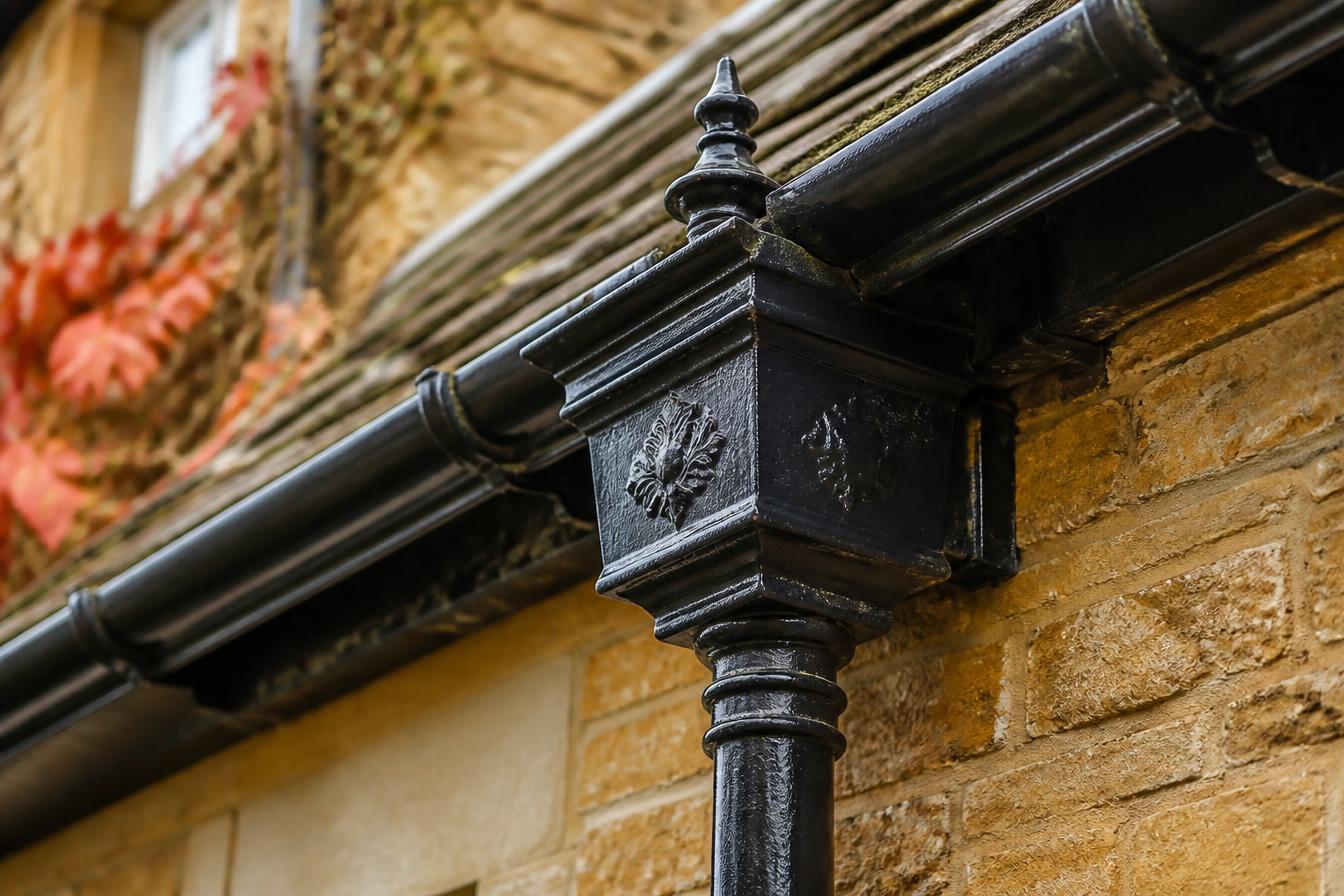
Traditional rainwater goods do more than move water off a roof. On a Cotswold stone cottage, a Georgian rectory or a Grade II listed manor, the guttering is part of the elevation — its profile, its shadow line and its patina all read from the lane. Getting the supply and installation right is what separates a sympathetic restoration from a repair that ages the building overnight.
This guide sets out how we approach traditional guttering supply and installation across the Cotswolds, Oxfordshire, Gloucestershire, Wiltshire and Berkshire — from survey through to the final downpipe bracket.
What "traditional" actually means
For most Cotswold properties, traditional guttering means one of four materials:
- Cast iron — the honest choice for listed buildings, rectories, churches and period homes. Half round and ogee profiles in 100mm, 115mm and 125mm, hand-painted and jointed with putty and bolts.
- Copper — warm, self-weathering and long-lived. Suited to fine country houses, gate lodges and where a distinctive patina is wanted.
- Zinc — quieter than copper, ages to a soft grey and sits beautifully against limestone.
- Cast aluminium — a modern alternative that mimics cast iron profiles with far less weight, ideal where planners accept it or where cast iron has failed prematurely.
Standard extruded aluminium and PVC have their place on modern homes and outbuildings, but they rarely belong on a period Cotswold elevation.
Supply: sourcing the right profile
Traditional guttering is not a stock item you pull off a shelf. The profile, the size and the fixings all need to match what the building was built for.
Before we order anything we survey the property, measure existing runs, identify original brackets and hoppers where they survive, and check for listed building consent requirements. Bespoke hoppers, swan necks and ornamental brackets are drawn up and cast or fabricated to match.
Lead times vary — bespoke cast iron hoppers can take six to eight weeks. Planning the supply properly is often the difference between a smooth installation and scaffolding standing idle.
Installation: what a good job looks like
A traditional guttering installation is a slow, careful trade. On a typical Cotswold cottage the sequence is:
- Scaffold or tower access — never ladders for anything more than a spot repair.
- Strip and inspect — the fascia, rafter feet and stonework behind the old gutter are often the real story.
- Repair timber and pointing — no gutter should be fixed back onto rotten timber or failing lime pointing.
- Set the fall — traditionally 1:600, chalked out along the run before any bracket is fixed.
- Fix brackets to solid timber or stone — rise and fall brackets for stone eaves, top-fix brackets for fascias.
- Joint with putty and gutter bolts — the joint that lasts a hundred years, not a bead of silicone.
- Prime, undercoat and topcoat — inside and out, before the gutter goes up wherever possible.
- Downpipes with cast ears — offset via swan necks, discharging into a hopper, gully or soakaway.
Done properly, a cast iron system installed today should still be doing its job in the next century.
Where we work
Our studio is in Highworth, at the meeting point of the Cotswolds, north Wiltshire and the Vale of White Horse. We routinely install traditional systems in Burford, Chipping Norton, Stow-on-the-Wold, Bourton-on-the-Water, Moreton-in-Marsh, Cirencester, Painswick, Tetbury, Cheltenham, Woodstock, Charlbury, Lechlade, Fairford, Malmesbury, Marlborough and across the surrounding villages.
For larger commissions — country estates, ecclesiastical work, listed manor houses — we travel further into Berkshire, Somerset and the wider South of England.
What to ask a supplier and installer
If you are appointing anyone for traditional guttering work, the questions worth asking are:
- Which foundry or fabricator are the goods coming from?
- Are joints made with putty and bolts or with mastic?
- Is the paint system full four-coat, and is it applied before installation?
- What is the fixing detail into stone or timber?
- Is scaffolding included, and how are the eaves protected?
A good answer to each of those is a strong indicator of a job that will still look right in twenty years.
Talk to us
If you are restoring a Cotswold cottage, replacing failed cast iron on a country house, or specifying rainwater goods for a listed building, we would be glad to survey and advise. Every property is quoted individually — no two are the same.
Email guttering@austendawson.co.uk or use the contact form on any page.