
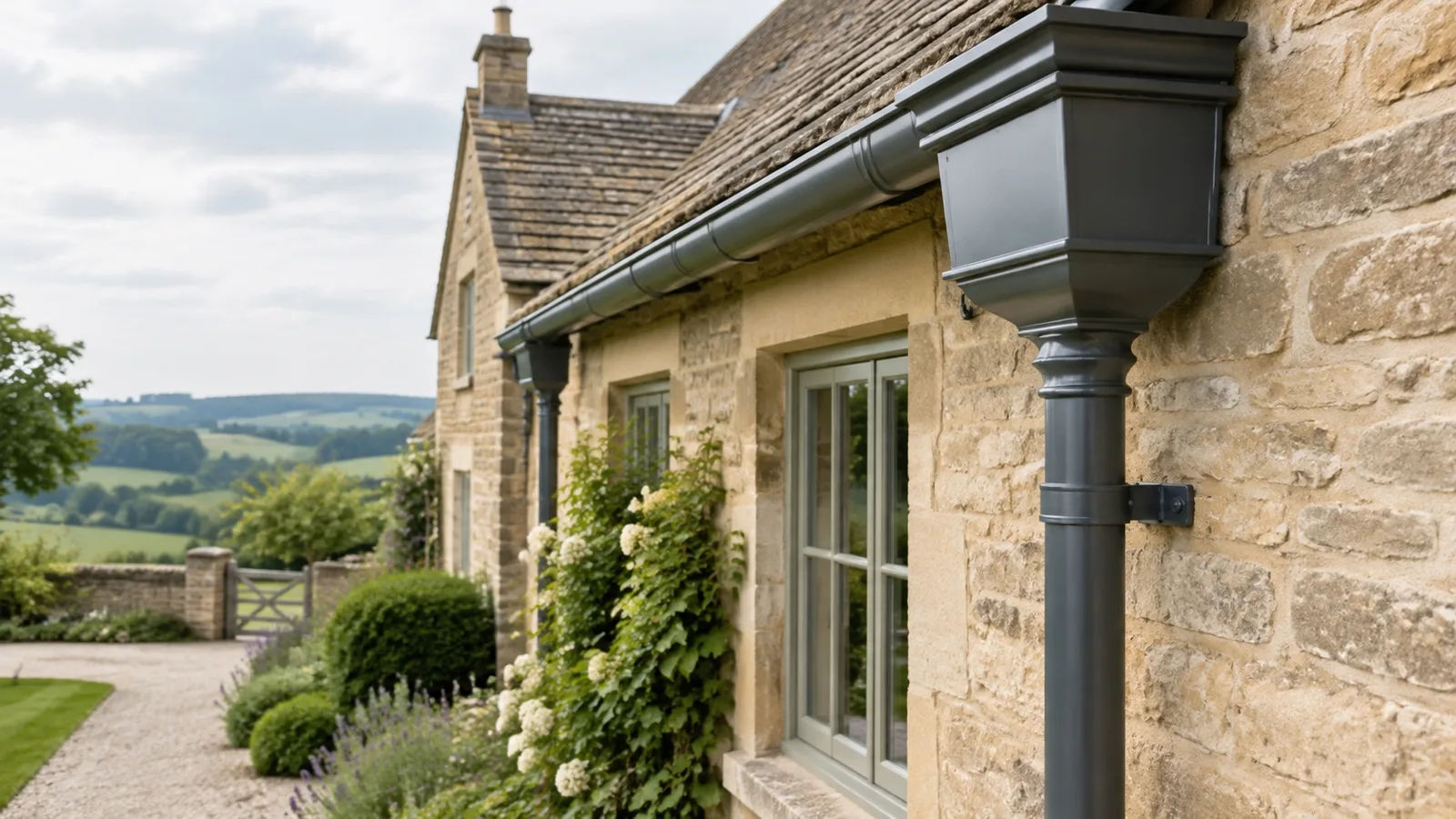
It is often said that the devil is in the detail, and nowhere is this truer than in the meticulous restoration and sympathetic upgrade of a period or listed property. When standing before a handsome Cotswold stone manor, a Georgian rectory in Oxfordshire, or a timber-framed farmhouse in Wiltshire, the eye naturally traces the elevations. One takes in the mellow local stone, the delicate glazing bars of the sash windows, and the gentle pitch of the roofline. Yet so often, the element that truly anchors the facade, serving as the essential architectural punctuation that grounds the building in history, is the rainwater scheme.
Water management on historic buildings was never conceived as purely utilitarian plumbing to be tucked out of sight. To earlier architectural craftsmen, guiding rainfall from sweeping roof valleys, parapets, and stone eaves down to ground level offered an irresistible canvas for artistic expression. At the very heart of this craft lie bespoke lead hoppers and classical downpipes, functioning as the defining architectural jewellery of a period home.
The Historic Role and Decorative Artistry of Rainwater Heads
Rainwater hoppers, historically known as cistern heads, originated out of practical necessity. In traditional English architecture, they functioned as open collection reservoirs and air breaks, capturing sudden torrents of runoff from complex roof slopes, high parapets, and internal lead valleys before funnelling the deluge into a single vertical downpipe. Because sudden cloudbursts could easily overwhelm narrow vertical pipes, the generous basin of a hopper prevented overspill, acting as a crucial surge buffer.
Master plumbers and leadworkers quickly recognised that these prominent junction boxes offered an exceptional decorative opportunity. By the seventeenth and eighteenth centuries, hoppers had evolved into grand statements of intent. Wealthy landowners commissioned intricate sand-cast lead heads bearing family crests, heraldic beasts, coats of arms, and proud date plaques commemorating marriages, extensions, or original construction dates.
Today, bespoke lead hoppers retain that exact same power to transform a building's elevation. Unlike contemporary drainage components that attempt to disappear into the background, a finely proportioned lead hopper celebrates the journey of water. Replacing an inappropriate, degraded modern pipe with an authentic lead hopper immediately draws the eye upward, celebrating the building's vertical lines and lending gravitas to an entrance or gable that previously lacked visual definition.
Material Integrity: The Enduring Art of Hand-Crafted Lead
For centuries, lead has stood as the premier material for critical waterproofing and rainwater management on fine British buildings. Its enduring reputation stems from two distinct qualities: exceptional malleability during fabrication and unparalleled resilience against the elements once installed.
Lead's natural malleability allows skilled craftsmen to form bespoke shapes, crisp cast relief motifs, and embossed flourishes that catch the raking light across historic stone and brick facades. Unlike mass-manufactured, off-the-shelf alternatives, a bespoke lead hopper is unique, tailored precisely to the architectural proportions, pitch, and quirks of the building it serves. Whether incorporating simple fluting, chamfered corners, or ornate monograms, hand-crafted leadwork reflects traditional trade skills passed down through generations.
Unlike ferrous metals or modern synthetic coatings, lead does not peel, flake, or rust. Instead, exposure to the weather causes it to develop a natural, self-protecting patina. Over decades, this surface oxidation matures into a soft, velvety, silvery-grey hue that harmonises effortlessly with Cotswold rubble stone, weathered lime mortar, handmade clay tiles, and warm red brickwork. It settles gracefully into its surroundings, aging in quiet conversation with the English seasons.
Complementary Downpipe Materials: Cast Iron and Classical Alternatives
While a bespoke lead hopper often commands attention as the focal point, the downpipes that carry water to the ground are just as critical to the visual and historical cohesion of the property. The junction between the hopper outlet and the downpipe must be both mechanically sound and visually harmonious.
Traditional Cast Iron Downpipes
For many listed properties across Gloucestershire, Berkshire, and Oxfordshire, genuine cast iron downpipes remain the gold standard partner for decorative lead hoppers. Cast iron provides a substantial structural presence, remarkable strength, and a tactile authenticity that lightweight modern materials simply cannot match. From traditional cast pipe clips and decorative ears that anchor the pipe into thick masonry, to substantial astragal mouldings and ornamental plinths, every fitting reflects authentic craftsmanship. Furthermore, cast iron brings a sensory quality familiar to period properties, including the satisfying clink of rain descending through heavy ironwork during a sudden downpour.
When properly cared for, cast iron systems can be repaired, maintained, and repainted across generations, providing decades of dependable protection while preserving irreplaceable period character.
Cast Aluminium, Copper, and Zinc
Depending on specific conservation requirements, regional vernacular styles, and client preferences, several other traditional materials provide excellent alternatives:
- Cast Aluminium: Ideal for properties where weight considerations or lower ongoing painting maintenance are factors, cast aluminium provides a traditional, weighty aesthetic that closely mimics the classic profiles and textured appearance of cast iron.
- Copper and Zinc: These metals deliver distinctive architectural impact, aging gracefully over time with unique colour transformations that complement specific stone types and vernacular building traditions.
- Cast Iron Effect Systems: For sympathetic newer builds or properties where reduced maintenance is desired without sacrificing visual character, high-quality cast iron effect guttering meticulously replicates traditional textured finishes, jointing details, and classic bracketry.
Aligning Rainwater Schemes with Historic Architectural Periods
Every architectural era expresses a distinct relationship between proportion, ornamentation, and function. When planning a sensitive restoration or upgrade, bespoke rainwater components should be designed to reflect the property's specific lineage.
Georgian Balance and Symmetry
Georgian townhouses and country homes demand understated restraint and pure geometric harmony. Hoppers from this period typically feature clean rectangular or semi-circular profiles, refined dentil mouldings along the upper rim, and modest date plaques centered on the face. Paired with round or square downpipes aligned neatly between window bays, the rainwater scheme reinforces the ordered symmetry of the facade.
Victorian Exuberance and Capacity
Victorian architecture often brought greater visual complexity alongside steeper roofs and larger catchment areas. Victorian hoppers are characterised by deep, generous basins, ornate cast filigree patterns, bold lion-head motifs, and decorative cresting. These substantial hoppers were designed to handle heavy volumes of water running from slate roofs while providing an imposing decorative statement on broad gable walls.
Arts and Crafts Individuality
Properties rooted in the Arts and Crafts tradition celebrate the visible mark of the craftsman's hand. Rainwater heads for these homes often showcase hand-beaten leadwork, softened curves, tactile relief work, and honest, visible fixings that highlight the raw beauty of natural lead and copper.
Vernacular Simplicity
For rural Cotswold cottages, historic farmhouses, and vernacular stone outbuildings, an overly ornate hopper can feel jarring. In these settings, simpler hoppers with clean chamfered corners, subtle stepped mouldings, or simple utilitarian funnel profiles allow the natural patination of the lead and surrounding stonework to speak for itself.
Hydraulic Engineering Behind the Heritage Ornament
While the historic charm and visual prestige of bespoke lead hoppers are undeniable, their primary duty remains uncompromising: protecting the building fabric from water ingress. Historic houses move, settle, and present complex rooflines that standard modern components struggle to drain effectively.
Period roofs, frequently steep and covered with heavy stone slates or handmade clay tiles, shed massive volumes of water very quickly. Modern off-the-shelf guttering and narrow downpipe throats often lack the capacity required to drain broad parapet gutters or multi-pitched valleys during intense storms. When rainwater systems become choked, the resulting overflow saturates porous stone walls, breaks down lime mortar joints, and leads to damp, timber rot, and internal plaster damage.
A bespoke approach resolves these hydraulic challenges through precise tailoring:
- Surge Buffering: Generously sized hopper basins act as temporary surge tanks, absorbing sudden peaks in water flow from multiple valleys without backing up.
- Air Separation: As water cascades into an open hopper head, air is introduced, breaking the vacuum and allowing water to drop smoothly down the vertical pipe rather than choking at the intake.
- Custom Throat Dimensions: The internal outlet of the hopper is fabricated to match the precise square footage and pitch of the roof area it drains, ensuring uninterrupted discharge.
- Discreet Overflow Spouts: Traditional hoppers can be fitted with subtle overflow weirs, directing excess water visibly away from the wall plane during unprecedented storms, acting as an immediate visual alarm before internal masonry suffers.
A Complete Rainwater Approach: Protecting the Roofline
A truly successful heritage rainwater scheme requires holistic planning across every component of the roofline. Beautiful hoppers and downpipes cannot perform their protective role in isolation; they must function in complete harmony with the gutters, fascias, and soffits.
Historic masonry frequently presents unique installation hurdles. Stone eaves may waver, exterior walls rarely sit perfectly plumb, and downpipe drops must often navigate decorative string courses, plinths, and protruding stone ashlar quoins. At Bespoke Guttering Solutions by Austen Dawson, careful planning ensures that pipe offsets, swan-neck bends, and cast fixings are positioned with precision, securing rainwater goods firmly without cracking fragile stone or historic brickwork.
Where original lead or cast iron elements survive on site, restoration should always be explored before replacement. Salvageable hoppers and pipe brackets can frequently be repaired, cleaned, re-dressed, and re-secured, honouring the historic material already present within the building's narrative.
Modern Versatility Alongside Heritage Restorations
While crafting and installing bespoke lead hoppers, copper details, and traditional cast iron remains a cornerstone of heritage work throughout Gloucestershire, Wiltshire, Oxfordshire, Berkshire, and the Cotswolds, superior rainwater management is equally vital for contemporary domestic homes.
A property does not need to be Grade II listed to deserve robust, thoughtfully installed guttering. Alongside dedicated heritage restorations, Austen Dawson provides high-performance seamless aluminium guttering, heavy-duty aluminium downpipes, and fascia and soffit renewal for everyday residential properties, modern family homes, and contemporary extensions.
Seamless aluminium provides sleek, continuous, leak-free runs that require minimal ongoing maintenance, proving that the principles of quality craftsmanship, precise site surveying, and hydraulic integrity apply whether working with eighteenth-century sand-cast lead or modern architectural metals.
Frequently Asked Questions
Why are bespoke lead hoppers recommended for listed buildings?
Planning authorities and conservation officers across areas like the Cotswolds and Oxfordshire place strict emphasis on maintaining the visual authenticity and material integrity of Grade II and Grade II* listed buildings. Bespoke lead hoppers allow for the exact replication of historic designs, proportions, and decorative motifs, ensuring that replacement rainwater goods respect the building's heritage rather than introducing visually jarring modern substitutes.
How do lead hoppers protect heritage walls from rainwater damage?
Lead hoppers act as open reservoirs and air breaks at junctions where multiple gutters, parapets, or roof valleys converge. By providing vital surge capacity during torrential downpours, they buffer heavy volumes of water before funnelling it into downpipes. This prevents rainwater from backing up, splashing over eaves, or saturating vulnerable lime mortar, stone ashlar, and underlying structural timbers.
Can existing cast iron and lead rainwater components be restored?
Yes. Heritage rainwater systems do not always require complete replacement. Where existing lead hoppers or cast iron downpipes remain structurally sound, professional restoration can salvage original components. Skilled lead dressing can repair minor damage, while cast iron can be carefully cleaned, repaired, and repainted, keeping original architectural features in service.
What downpipe materials pair best with decorative lead hoppers?
Genuine cast iron downpipes are the most traditional and historically accurate partner for lead hoppers, offering unmatched structural weight, authentic astragal mouldings, and decorative ear fixings. High-capacity cast aluminium downpipes also pair exceptionally well, offering a durable, traditional appearance with reduced weight, while copper and zinc provide striking visual harmony for specific vernacular architectures.
How does lead patination develop over time?
Unlike painted or coated metals that can blister and peel, lead oxidises naturally when exposed to the elements. This chemical reaction creates a self-protecting, durable surface patina that transitions over time into a soft, velvety, matte silvery-grey colour. This natural oxide layer shields the underlying metal from decay and harmonises seamlessly with historic brick, slate, and natural stone.
If your cherished period property or historic home would benefit from a bespoke rainwater scheme designed to honour its heritage and provide lasting protection, request your free estimate today.