
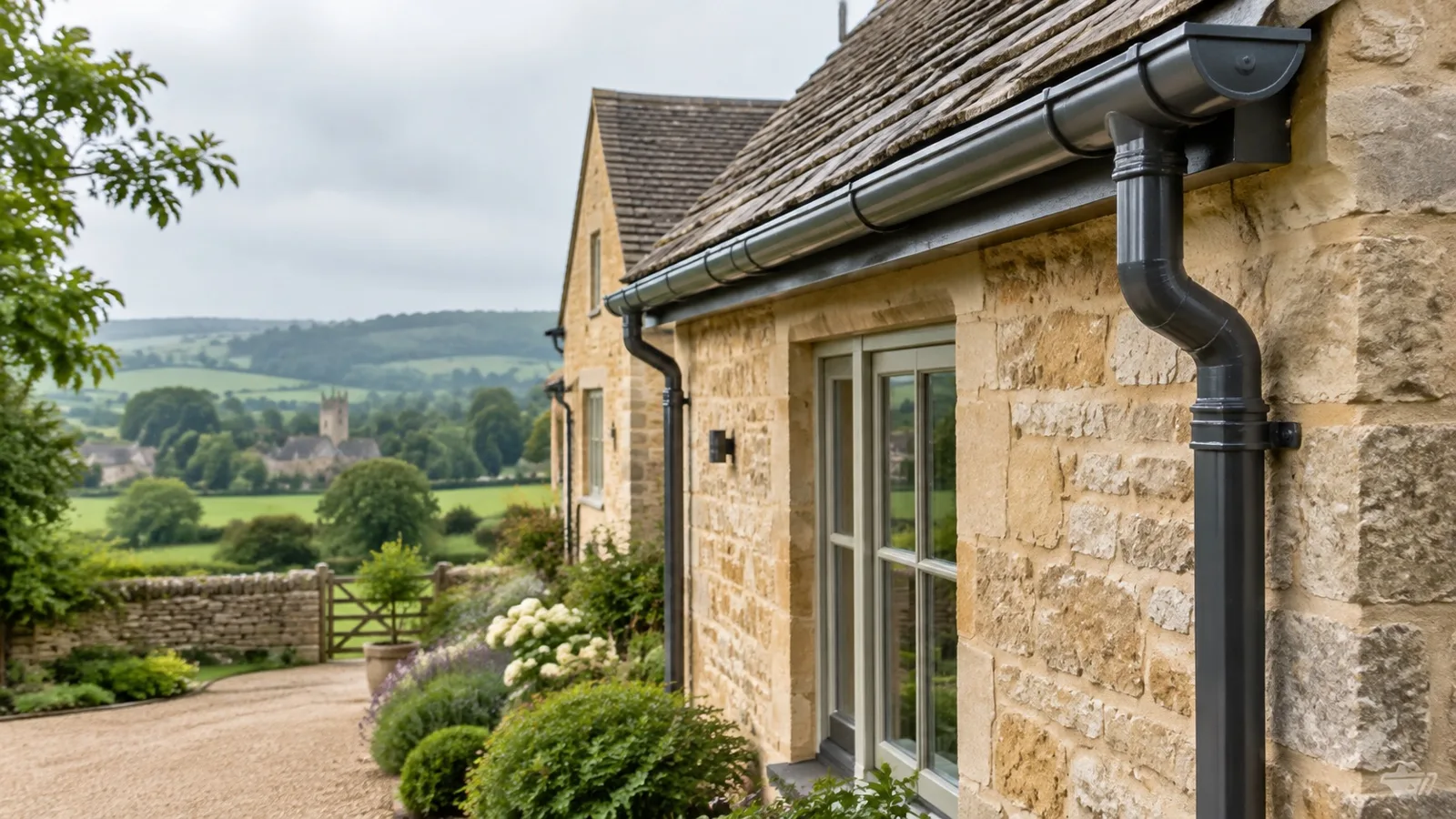
There is a particular drama to a sudden storm sweeping across the Cotswold escarpment. Within minutes, gentle summer skies or quiet autumnal afternoons give way to torrential downpours that test every joint, valley, and bracket of a property. When water begins to sheet over the edge of a roofline—cascading onto stone paving, soaking lime mortar, and splashing back against delicate foundations—the instinctive reaction is to suspect a blockage.
More often than not, however, the problem is not a handful of autumn leaves or a rogue tennis ball. The issue is far simpler and fundamentally hydraulic: the rainwater system is simply too small for the volume of water the roof is asking it to carry.
The Mathematics of Roof Area and Run-off
Rainwater management is an exact science governed by flow capacity and catchment calculations. When designing or upgrading a system, we do not simply measure the footprint of your home on the ground. A flat architectural plan tells only part of the story.
Under British Standards (specifically BS EN 12056-3), sizing begins by calculating the ‘effective roof area’. This equation factors in the horizontal length of the roof, its projection, and crucially, its pitch. The steeper the pitch, the greater the surface area exposed to wind-driven rain.
Across Oxfordshire and Gloucestershire, vernacular architecture often favours steeply pitched roofs clad in heavy Cotswold stone slates or handmade clay tiles. A 45- or 50-degree pitch accelerates run-off significantly compared to a shallow modern roof. Rain hits the surface and races downward with tremendous momentum. If the gutter profile awaiting that torrent at the eaves has an inadequate cross-sectional area, surface tension breaks, the profile floods, and water spills over the front lip.
When Wiltshire and Gloucestershire Storms Strike
Our regional climate has shifted in recent years towards shorter, vastly more intense cloudbursts. A system sized purely for persistent English mizzle will inevitably struggle when an August thunderstorm dumps twenty millimetres of rain over a Wiltshire valley in fifteen minutes.
Undersized outlets and downpipes are the usual culprits behind mid-storm overflows. A gutter can only drain as swiftly as its outlets allow. A standard 100mm half-round gutter paired with a 68mm circular downpipe might cope admirably on a modest single-storey rear extension, but place that same specification beneath a large, two-storey span of slate, and it becomes a bottleneck.
When water backs up at the outlet, hydraulic drag reduces the velocity of the entire run. The gutter fills from the outlet backwards, creating standing weight that strains brackets, loosens fixings on older fascias and soffits, and eventually overflows into the fabric of the building.
Sizing Profiles: From Seamless Aluminium to Cast Iron
Addressing flow capacity does not mean saddling a handsome property with unsightly, industrial-scale troughs. Modern rainwater engineering offers an array of profiles and materials designed to handle high capacities while respecting regional aesthetics.
For period homes, traditional cast iron remains peerless. Choosing a deep-flow half-round or a generous moulded Ogee profile allows an authentic heritage restoration to quietly double its water-carrying ability without looking out of scale. Ornamental lead hoppers can also serve a vital hydraulic role; rather than being purely decorative, a well-placed hopper acts as a surge tank, absorbing sudden deluges and feeding downpipes at a controlled, steady rate.
For contemporary builds and post-war homes across Berkshire and the surrounding counties, modern aluminium guttering provides clean lines with exceptional capacity. Deep-flow seamless aluminium systems, extruded on site in continuous lengths, eliminate joint leaks while offering a significantly higher volume than conventional plastic alternatives. At Bespoke Guttering Solutions by Austen Dawson, we approach everyday domestic aluminium jobs with the same meticulous engineering mindset that we apply to bespoke heritage rainwater systems on listed country houses.
The Key Factors in Rainwater System Design
Every roofline presents its own puzzle, but calculating the right combination of gutter depth and downpipe frequency invariably hinges on several practical considerations:
- Roof Pitch and Catchment: Accounting for the vertical rise of the roof to establish true wind-driven water collection.
- Design Rainfall Intensity: Factoring in localized storm thresholds rather than generic national averages.
- Profile Geometry: Selecting deep-flow, box, or Ogee shapes that maximize volume within an architecturally pleasing footprint.
- Outlet Positioning: Positioning drops to minimize travel distances and prevent water from lingering in long, shallow-pitched runs.
- Downpipe Dimensions and Bends: Choosing pipe diameters that swallow peak flows without creating back-pressure at bends or shoes.
Protecting Your Home for the Decades Ahead
An overflowing gutter is never merely an inconvenience; over time, the persistent soaking of masonry leads to penetrating damp, damaged timber eaves, and costly foundation settlement. Ensuring your rainwater goods are sized appropriately is one of the most effective structural investments you can make for your home.
If you have concerns about how your property handles heavy weather, we would be delighted to carry out a comprehensive rainwater survey and advise on the ideal flow solution for your roofline.