
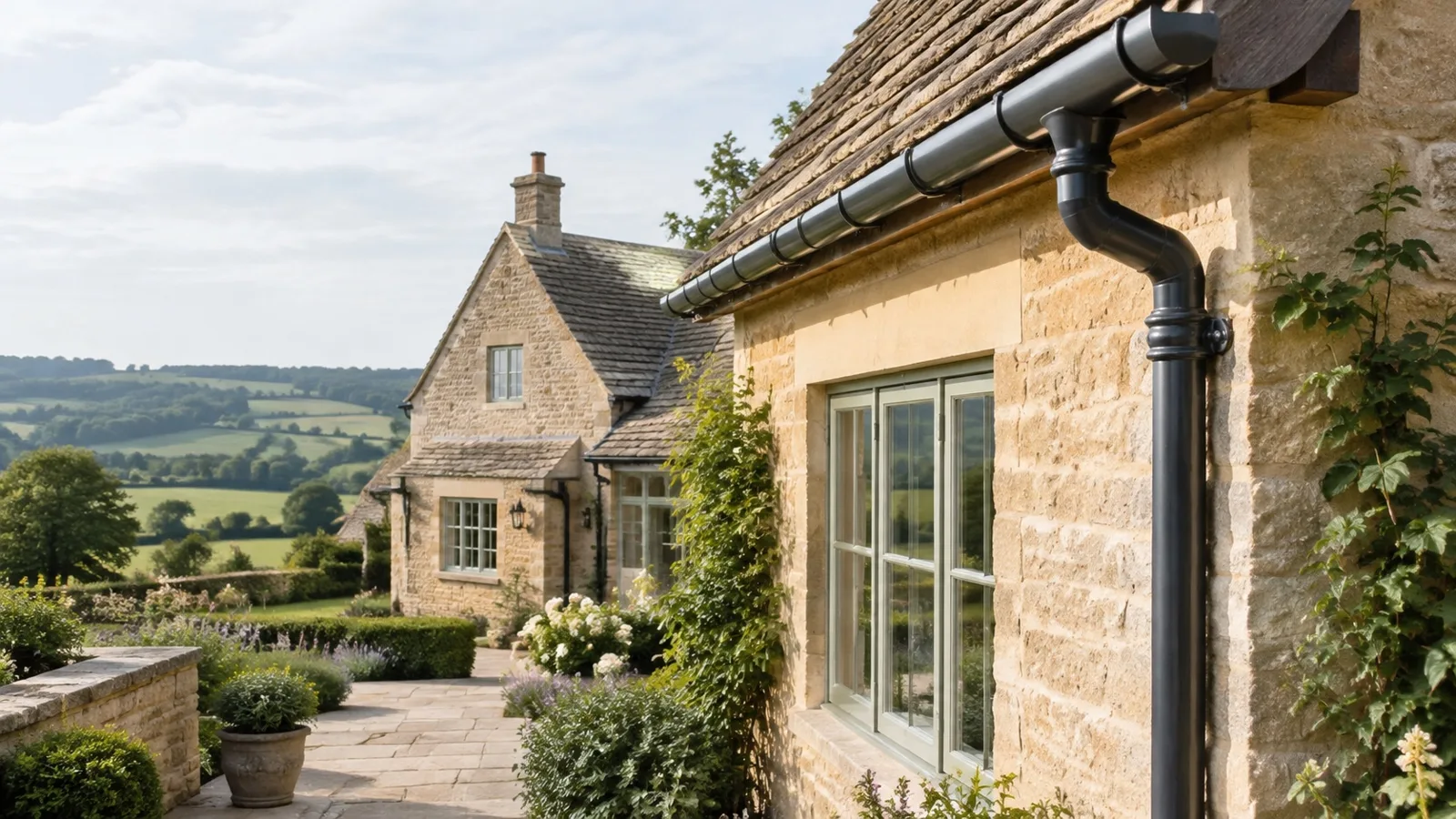
There is a distinctive warmth to an afternoon in the Cotswolds. Whether wandering through a riverside hamlet in Gloucestershire or admiring an ancient market square in West Oxfordshire, the landscape is defined by its oolitic limestone. Glowing in shades from pale buttermilk to deep, crumbly amber, this stone carries centuries of craft within its surface. Yet even the most beautifully laid rubble wall or refined ashlar facade can be undone by an ill-considered roofline.
Rainwater systems are often treated as pure utility, installed merely to guide downpours away from brickwork and foundations. But on a stone-built home, gutters and downpipes act like the picture frame around a masterpiece. Choose the right line, depth, and finish, and the architecture sits in quiet harmony with its environment. Choose poorly, and stark modern plastic can draw the eye for all the wrong reasons.
A Matter of Tone: Working with Natural Limestone
Cotswold stone is rarely a single flat colour. Across Gloucestershire, Oxfordshire, and down towards the Wiltshire borders, the stone shifts with the quarry it came from and the light of the season. In bright sunshine, it reflects a soft, warm cream; under autumn rain, it deepens to rich biscuit and burnt gold.
Because limestone has such organic depth, high-gloss pure white rainwater goods create an aggressive contrast that feels completely out of place. Instead, rainwater systems should either ground the building or gently recede into the eaves.
Heritage black remains the perennial favourite for good reason. Emulating the traditional look of bitumen-painted cast iron, a textured black profile frames natural stone sharply against Welsh or Cotswold stone slate roofs. However, darker shades such as graphite, slate grey, and weathered bronze are increasingly finding their place. An earthy, dark charcoal will often echo the lichen and weathering on older stone slates far more sympathetically than a stark, brand-new black.
Classic Materials: From Cast Iron to Architectural Aluminium
Historic properties invariably demand materials with gravitas. Cast iron has long been the gold standard for period restoration across our region, offering the authentic weight, beaded collars, and historic brackets that conservation officers expect on listed properties. It possesses a tactile, solid presence that looks immediately at home against thick masonry.
Yet modern engineering offers remarkable alternatives that respect historic character without the heavy maintenance cycle of traditional ironwork. High-grade aluminium guttering has become a firm favourite across the region for both renovations and new builds. When finished in a matt, architectural powder coating—often referred to as cast iron effect—it replicates the textured surface and traditional cast joints of iron while remaining lightweight, rust-free, and exceptionally durable.
For properties requiring clean, continuous lines, seamless aluminium provides a sleek, leak-free run that protects valuable stonework from the staining that joint leaks inevitably cause. At Bespoke Guttering Solutions, we work comfortably across this full spectrum: we handle everyday domestic aluminium jobs on modern family homes just as readily as we deliver bespoke heritage rainwater systems on listed country estates.
Choosing the Right Profile for Your Eaves
Scale and geometry matter immensely when looking up from garden level. The profile of your gutter should mirror the architectural ambition of the building beneath it:
- Half Round: Simple, honest, and timeless. A deep half-round gutter suits low-eaved Cotswold cottages, converted stables, and outbuildings where unpretentious, functional beauty is needed.
- Moulded Ogee: Featuring a decorative, curved frontal lip reminiscent of classical stone cornicing, Ogee profiles bring elegance to grand Georgian facades, townhouses, and substantial Victorian parsonages.
- Deepflow Profiles: Ideal for steep-pitched roofs clad in heavy stone slates, offering the increased water-carrying capacity required during sudden seasonal downpours without sacrificing aesthetic balance.
- Ornamental Lead Hoppers: Positioned beneath valleys and dormers, decorative hoppers—whether cast with dates, initials, or simple heritage motifs—add an undeniable touch of craftsmanship to a stone gable.
The Roofline Details: Fascias, Brackets, and Fixings
It is easy to focus entirely on the gutter trough itself, but the method of fixing is equally critical to the overall appearance. Many traditional stone properties throughout Wiltshire and the Cotswolds lack conventional timber fascias and soffits, relying instead on rafter-bracket fixings or decorative stone corbels built straight into the wall.
Where timber fascias are present, their condition must be assessed alongside the guttering. Rotten timber or clumsy modern uPVC cladding will compromise the alignment of even the finest rainwater system. Sympathetically restored, painted timber fascias paired with rise-and-fall drive brackets driven directly into the stone joints keep the eaves neat, breathable, and historically coherent.
Downpipes should also be scaled appropriately. Slender, round downpipes with traditional cast ears soften the corners of a building, guiding the eye gently from roofline to ground without interrupting the masonry’s natural rhythm.
Protecting Your Stone for Decades to Come
Water is both the creator of the Cotswold landscape and its greatest threat. Porous limestone readily absorbs moisture, and an overflowing, misaligned, or cracking gutter will quickly cause damp patches, wash out lime mortar, and stain golden walls green with algae. Ensuring your rainwater goods are sized correctly for your roof area is just as vital as choosing the right shade of grey or black.
Whether you are caring for a 17th-century thatched cottage or building a sympathetic new stone extension, getting your rainwater details right is one of the most rewarding improvements you can make to your home’s kerb appeal.
If you would like experienced guidance on selecting the ideal profiles and materials for your home, we would be delighted to arrange a detailed on-site survey.