
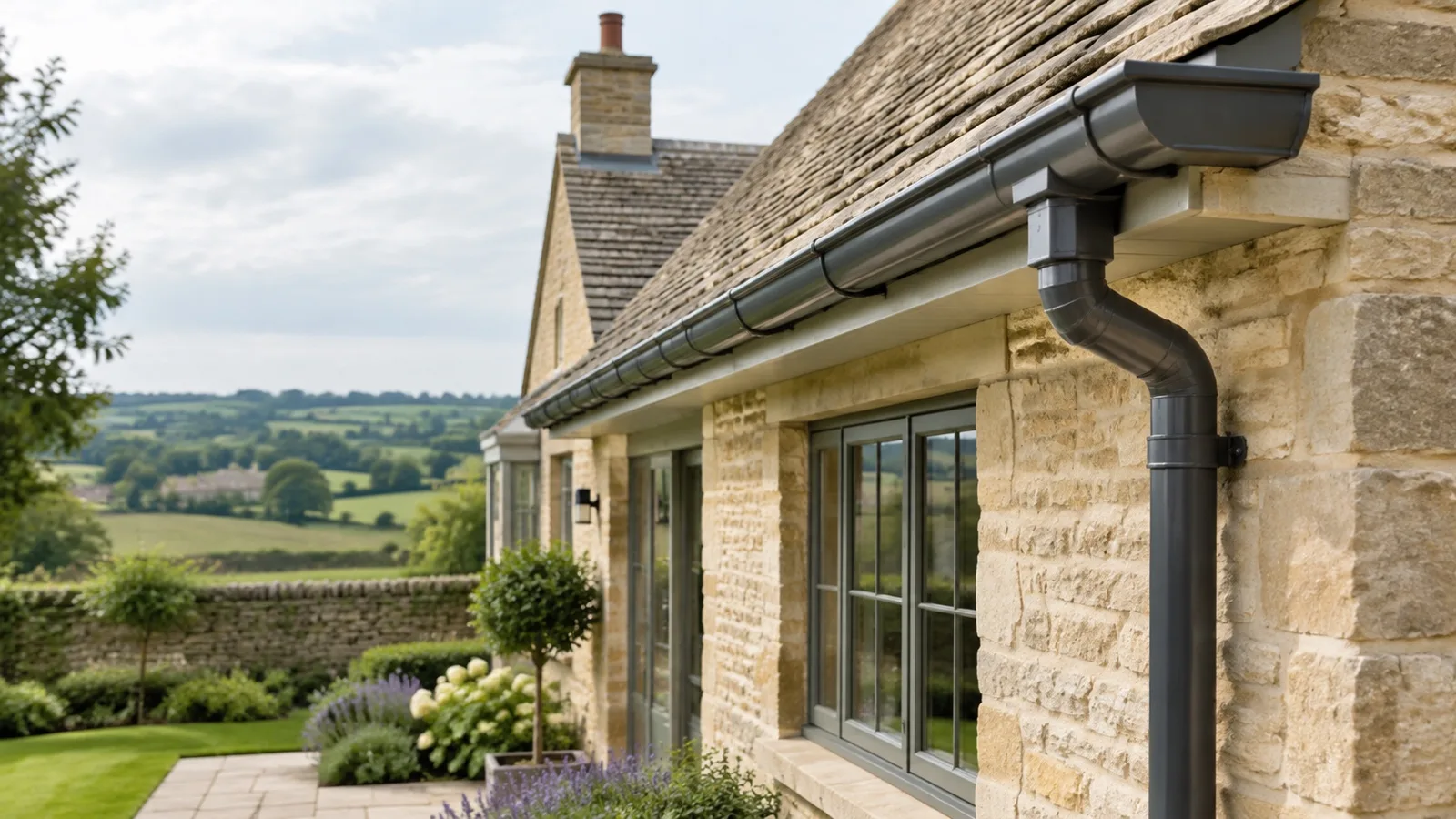
Look up beneath the eaves of almost any home across Oxfordshire or Gloucestershire, and you will see an intricate junction where roof tiles, rainwater goods, and roofline joinery meet. When rainwater begins to cascade down exterior brickwork or seep into wall cavities, the natural impulse is to look immediately at the gutters. Yet, gutters do not exist in isolation. They are anchored firmly to the fascia boards, sheltered by the soffits, and dependent upon the sound health of the underlying timber.
Homeowners frequently ask us whether it is genuinely necessary to replace fascias and soffits at the same time as installing new guttering. While tackling everything simultaneously represents a larger initial investment, in the vast majority of cases, separating the two jobs proves to be a false economy. Understanding how these elements interact reveals why a unified approach makes both structural and financial sense.
The Structural Link Behind Your Gutters
A gutter system carries an astonishing weight of water during a typical British downpour, particularly during winter downpours when slush and melting snow add considerable load. Every bracket holding that weight is screwed directly into the fascia board. If that timber is softening, harbouring damp, or quietly decaying behind a fresh coat of paint, the new brackets simply cannot achieve a secure fix.
Too often, we are called to properties where brand new guttering has begun to pull away from the roofline within a matter of months. Invariably, the issue does not lie with the guttering itself, but with the tired timber beneath it. Replacing gutters while ignoring aged fascias is akin to hanging a heavy oak door on a crumbling frame. By renewing the fascias and soffits at the same time, you ensure the entire roofline is structurally sound, allowing brackets to bite into solid, preservative-treated timber or durable composite substrates that will hold firm for decades.
The Economics of Scaffolding and Labour
Beyond structural integrity, the purely practical arithmetic of building work makes a compelling argument for combined renewal. A substantial portion of the cost of any high-level exterior maintenance lies in safe access and setup. Scaffolding or dedicated access towers must be erected, whether an installer is on site for a single day to clip up gutters or for several days to rebuild the roofline.
If you replace your guttering this spring, and discover two years down the line that the fascias behind them are rotting, the entire process must be repeated. The newly installed gutters will need to be carefully unclipped, taken down, stored, and reinstalled around the joinery replacement—with access equipment charged all over again. Combining the work eliminates redundant labour, halves the disruption to your home life, and ensures that tradespeople only need to scale your walls once.
Clear Signs It Is Time for a Complete Overhaul
While every property has its individual quirks, certain warning signs indicate that dealing with the gutters alone simply will not suffice:
- Peeling paint and dark staining: Flaking paintwork on the underside of timber fascias or along the soffits typically points to trapped moisture from overflowing gutters.
- Softness around bracket fixings: If existing gutter brackets feel loose or pull away easily with gentle pressure, the timber core has degraded.
- Persistent damp at the eaves: Staining inside the loft or high on upstairs ceilings suggests water is tracking back along rotten soffits rather than clearing the roof edge cleanly.
- Sagging roofline lines: When looking along the elevation, any noticeable dip or twist in the run often originates in distorted timber rather than bent brackets.
Balancing Heritage Character with Modern Performance
Every home demands a bespoke perspective. Across our work in the Cotswolds, Berkshire, and Wiltshire, we find that the choice of roofline approach must always respect the architecture of the building. We cater to everything from everyday domestic aluminium jobs on modern family homes through to meticulous heritage rainwater systems on listed properties.
For contemporary and mid-century homes, pairing low-maintenance uPVC or painted timber fascias with seamless aluminium guttering creates a crisp, durable, and highly efficient drainage line that requires minimal upkeep. Seamless aluminium eliminates joint leaks entirely along straight runs, making it an exceptional modern companion to fresh roofline joinery.
On older stone cottages and period estates, the approach shifts naturally towards careful conservation and restoration. Here, bespoke timber fascias and ventilated tongue-and-groove soffits can be paired with authentic cast iron profiles, heritage cast iron effect systems, or elegant zinc and copper detailing complemented by lead hoppers. Renewing the timber grounds during such a restoration guarantees that precious, heavy metalwork is permanently anchored without risking damage to historic rafter feet.
Taking down failed gutters presents the only genuine opportunity to inspect rafter tails, roof felt edges, and ventilation paths that are otherwise concealed for years. Addressing any decay at that moment protects the roof timbers, halts damp before it enters the loft space, and ensures your investment looks pristine from the ground up.
If you are considering updating your rainwater goods and want a clear, professional assessment of the timber beneath, please get in touch to arrange a comprehensive roofline survey.