
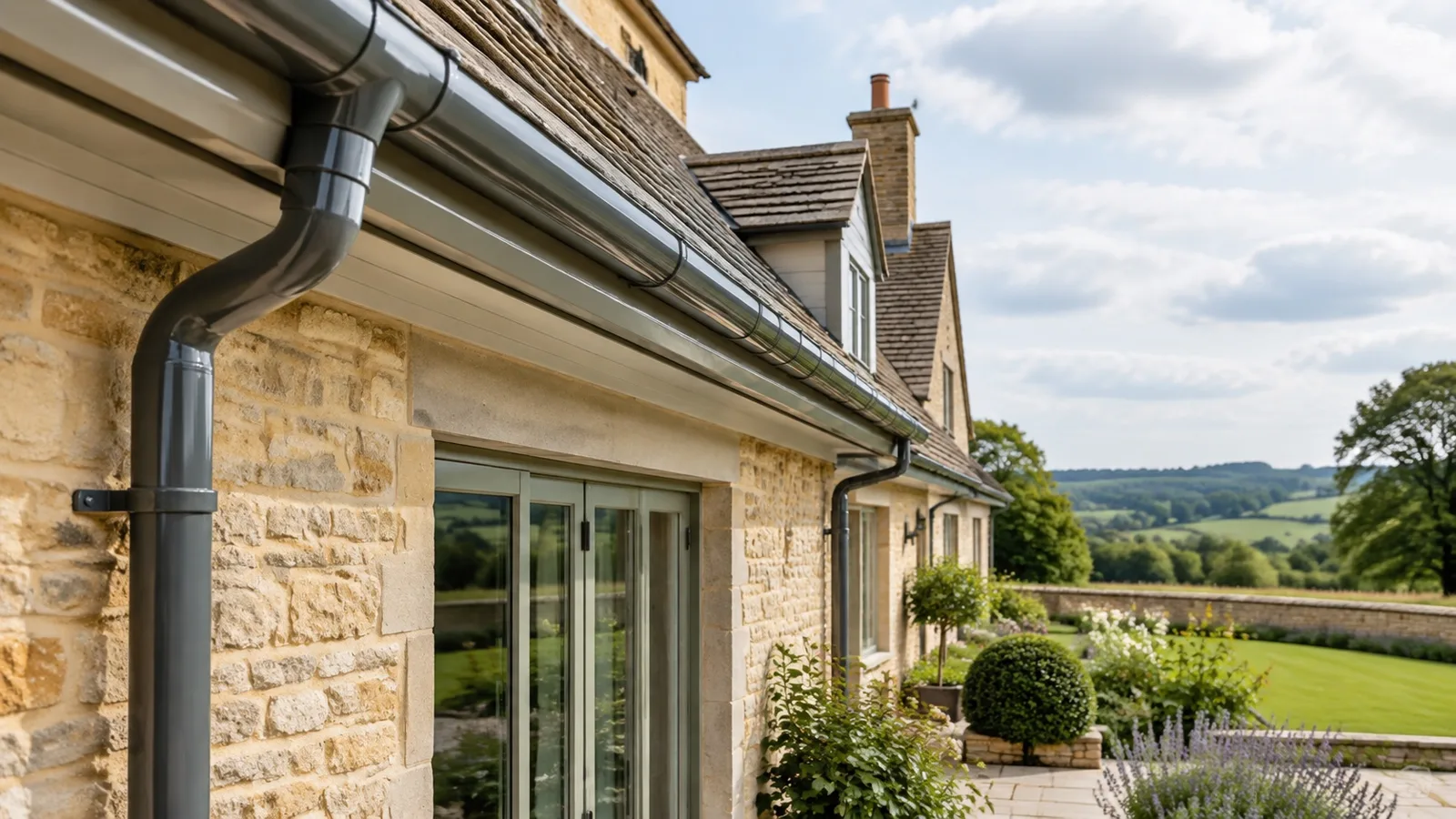
When torrential autumn downpours sweep across the rolling rooflines of the Cotswolds or the chalk hills of Wiltshire, our rainwater systems take the brunt of the weather. More often than not, it is a persistent drip, an unsightly sag, or water spilling over a joint that first catches a homeowner's attention. The instinctive reaction is simple: call someone to replace the gutters.
Yet, unhooking old rainwater profiles often reveals an uncomfortable truth. Tucked directly behind those troughs sit the fascias and soffits—the quiet workhorses of your roof's eaves. Too often treated as an afterthought, these timber or composite boards bear the structural weight of the brackets and shield your rafter feet from wind-driven moisture. Deciding whether to tackle both elements at once is one of the most common dilemmas we encounter, and while it requires an extra initial investment, the long-term rationale is remarkably compelling.
The Hidden Anatomy Behind Your Guttering
Rainwater systems do not exist in isolation. Your fascia board provides the sturdy vertical anchor point to which gutter brackets are secured, while the soffit bridges the gap underneath, sealing the overhang and ventilating the roof space.
When guttering fails—whether through cracked joints, moss blockages, or age—water regularly cascades down the face and back of the timber. Over months and years, this subtle saturation softens the timber beneath the paintwork. We frequently inspect properties where gutters appear securely fastened from the ground, yet upon closer examination from a ladder, the fixing screws are resting in little more than sponge-like, decayed wood.
Attaching new, high-performance guttering to tired, decaying timber is akin to laying new carpet over a rotting floorboard. The weight of heavy winter rainfall or snow will inevitably strain the fixings, causing the brand-new troughs to pull away and sag prematurely.
The Shared Economics of Access and Labour
The primary argument for renewing fascias, soffits, and gutters simultaneously comes down to simple economics. In exterior building work, a significant portion of project expenditure goes toward safe access, site setup, and skilled labour.
Erecting scaffolding or specialist access towers in tight Gloucestershire lanes or picturesque Oxfordshire hamlets represents a fixed investment. If you replace only the guttering this year, you pay for that access. If the underlying timber gives up the ghost three years later, you will pay for the exact same access again, alongside the labour cost of carefully detaching and refitting your relatively new gutter system.
By consolidating the work into a single scheduled project, you strip away redundant labour. The roofline is exposed cleanly, rafter ends can be inspected for historic rot, breathable felt trays can be neatly installed to prevent ponding at the eaves, and everything is renewed in one seamless sequence.
When Replacement Becomes Essential
While sound fascias can sometimes be preserved through careful carpentry and high-grade exterior finishes, full replacement becomes the only sensible pathway under specific conditions:
- Spongy or cracked timber: If a probe sinks into the wood behind the gutter brackets, structural integrity is already lost.
- Absence of eaves ventilation: Older soffits often lack adequate airflow, leading to condensation, damp loft insulation, and mould.
- Perished underfelt: If original roofing felt at the eaves has degraded, water runs behind the fascia rather than into the gutter.
- Upgrading to heavier materials: Switching to authentic cast iron or heavy-gauge profiles requires a rock-solid, load-bearing fascia board.
Complementing Historic Character and Modern Lines
Every home demands an individual touch. Across Berkshire, Gloucestershire, and throughout the Cotswolds, the architectural landscape ranges from honey-stone listed cottages to contemporary self-builds. Our work spans this exact breadth, from everyday domestic aluminium jobs to bespoke heritage rainwater installations.
For period properties, we often lean toward careful timber restoration paired with traditional cast iron or heritage cast iron effect profiles. Where historic authenticity is paramount, bespoke lead hoppers, copper, and zinc systems lend an unmistakable air of permanence. These materials require unwavering support at the eaves; marrying them with properly seasoned, meticulously painted timber fascias ensures they endure for generations.
Conversely, for busy modern households, pairing powder-coated seamless aluminium guttering with durable, low-maintenance fascias and vented soffits provides complete peace of mind. The result is a clean, razor-sharp roofline that requires minimal upkeep while deflecting the harshest British weather.
Renewing your roofline elements in unison transforms an exercise in damage control into an enduring enhancement of your home's structural health and kerb appeal.
If you are planning an upgrade to your rainwater system or suspect your timber roofline needs attention, we would be delighted to arrange a detailed on-site survey and talk through the options best suited to your property.