There is a distinct architectural honesty to an agricultural building. Across the Cotswolds, former threshing barns, cattle byres, and grain stores stand as masterclasses in vernacular building, anchored by thick rubble limestone walls and colossal expanses of stone slate. Yet, when converting these vast utilitarian structures into refined dwellings, one critical detail is frequently left as an afterthought: how to harvest and channel the immense volume of water rolling off the roof.
Unlike traditional village cottages, agricultural roofs are unforgivingly steep, expansive, and uninterrupted. Managing runoff on this scale demands rainwater goods that perform flawlessly under heavy rainfall while visually respecting the historic envelope.
The Scale and Demands of Agricultural Rooflines
Barn roofs are fundamentally different from standard domestic builds. The sheer square meterage of tile or slate means gutters must contend with substantial hydraulic loads. Standard residential profiles simply cannot cope with a sudden Cotswold deluge sheeting off a forty-five-degree pitch.
Furthermore, agricultural eaves often dispense with conventional fascias and soffits altogether. Instead, you are typically presented with exposed rafter feet, corbelled stone tables, or raw timber wall plates. Fixing gutters in these scenarios requires deep specialist knowledge. Standard bracketry will not suffice; installers must employ forged drive-in brackets embedded directly into the lime mortar joints, side-rafter brackets, or rise-and-fall fixings tailored to uneven historic masonry.
Honouring Provenance with Cast Iron and Lead
For curtilage-listed barns or properties sitting squarely within conservation areas across Gloucestershire and Oxfordshire, the conservation officer’s preference is almost always traditional cast iron.
There is an undeniable authenticity to genuine cast iron. Its heavy section, subtle surface texture, and traditional bolted collar joints sit naturally against honey-coloured rubble stone. Pair deep half-round cast iron gutters with ornamental lead hoppers, and you introduce an understated grandeur that feels entirely earned. Lead hoppers, whether cast with simple date stamps or tailored relief motifs, act as practical reservoirs that help high-capacity downpipes draw torrential water away from soft lime pointing.
Where structural weight or budget requires careful value engineering, high-grade cast iron effect aluminium offers an exceptional alternative. It retains the historic profiles and textured powder-coated finish of original foundry iron, whilst dramatically reducing the ongoing painting and maintenance cycle.
Modern Architectural Lines: Zinc and Architectural Aluminium
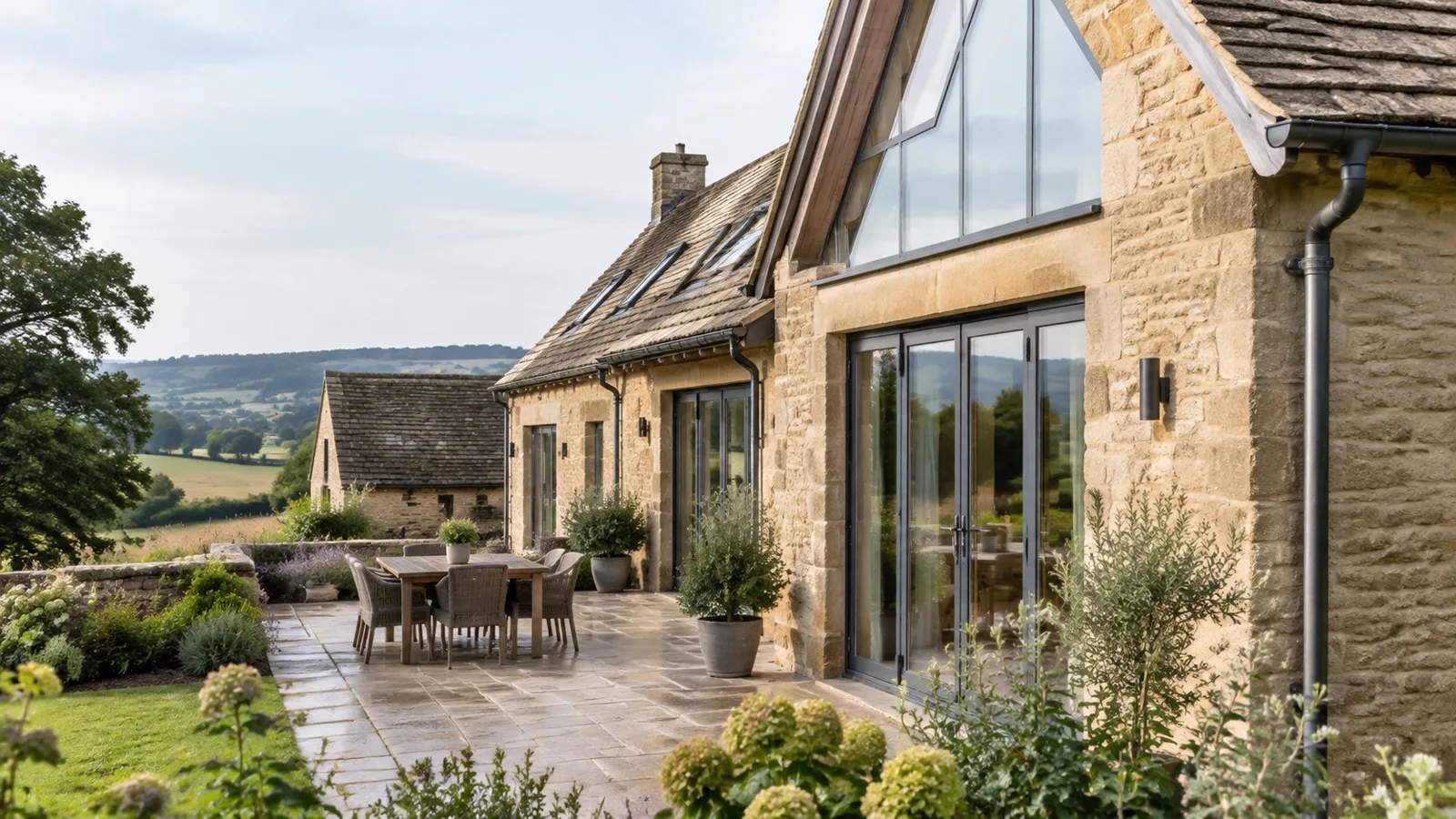
Not every barn conversion seeks to mimic the eighteenth century. Many of the most celebrated conversions in Wiltshire and the North Cotswolds adopt a confident, contemporary language—pairing original weathered stone with sharp Crittall-style glazing, black vertical timber cladding, and polished concrete.
In these hybrid schemes, overtly traditional guttering can sometimes feel like pastiche. Instead, contemporary systems provide a crisp, considered counterpoint:
- Extruded and pressed aluminium guttering: Finished in a durable, architectural polyester powder coat—frequently matt black or dark anthracite—aluminium delivers clean shadow lines and exceptional longevity without drawing undue attention to the eaves.
- Natural zinc: Particularly suited to conversions featuring standing-seam zinc extensions or roof dormers, zinc weathers over time to a soft, tactile grey that harmonises quietly with weathered stone.
- Seamless aluminium: For long, unbroken agricultural eaves, seamless aluminium profiles extruded on-site eliminate leak-prone intermediate joints across twenty- or thirty-metre runs.
- Untreated copper: Over decades, copper transitions from bright penny-bronze to rich verdigris, creating a striking narrative of natural weathering alongside historic oak timbers.
Navigating the Conservation and Practical Divide
The secret to successful rainwater design on an agricultural conversion lies in the detailing. Downpipes should ideally be grouped logically around natural structural bays, rather than cutting across expansive swathes of dressed stone. Hopper heads must be sized to prevent overtopping, and bracket centres must be calculated carefully to bear the weight of winter snow loading.
At Bespoke Guttering Solutions by Austen Dawson, we bridge the gap between traditional architectural metalwork and modern rainwater engineering. While much of our week is spent installing sleek, dependable domestic aluminium guttering on everyday family homes, we relish the complex demands of bespoke heritage restoration. Working across the Cotswolds, Oxfordshire, Gloucestershire, Wiltshire, and Berkshire, we treat each agricultural building as an individual piece of landscape history.
Whether your project calls for sand-cast iron restoration with hand-beaten lead hoppers or the crisp, minimalist lines of contemporary powder-coated aluminium, we would be delighted to visit your conversion and provide a comprehensive rainwater survey.