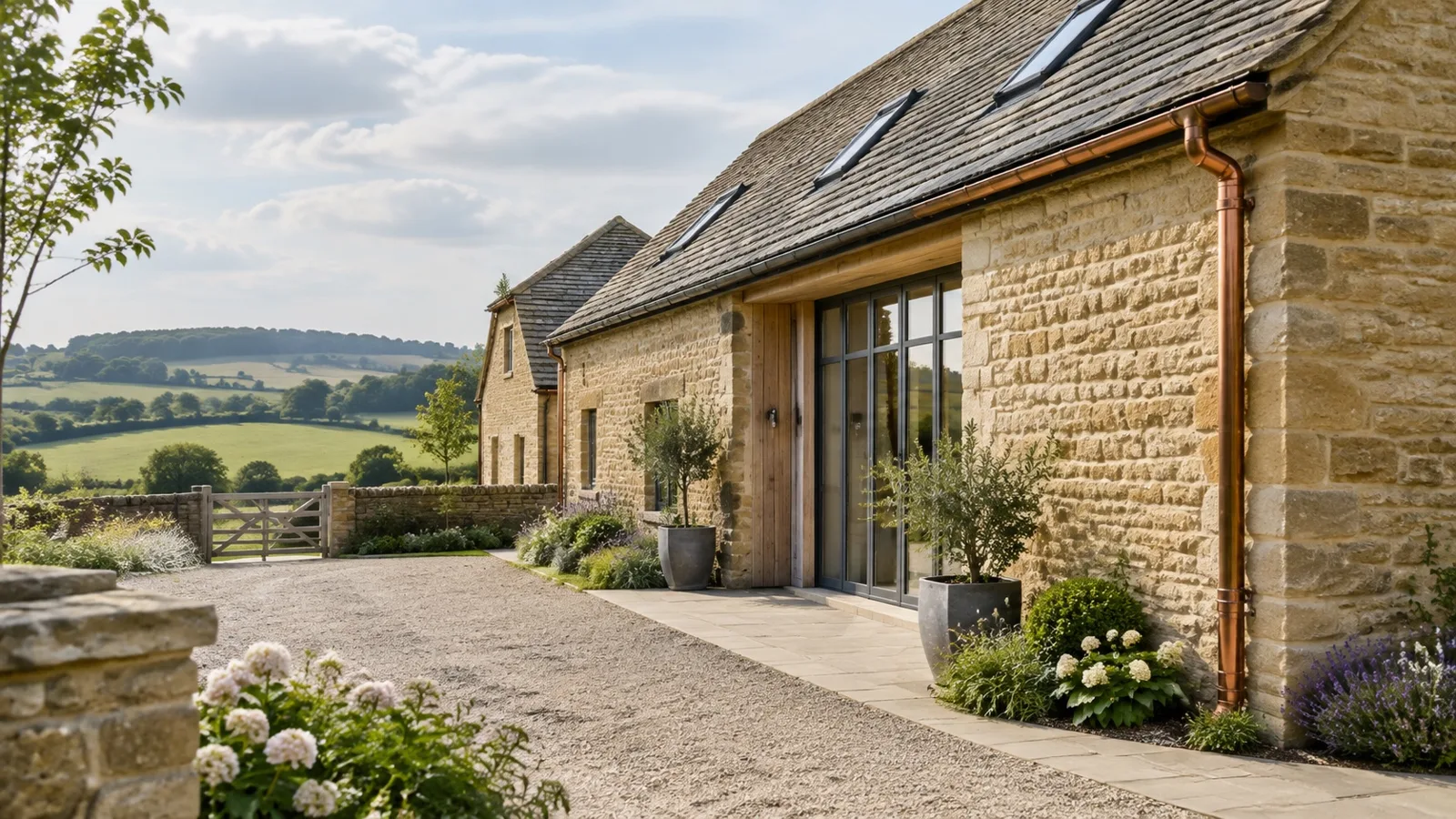
There is an undeniable romance to a Cotswold barn conversion. Whether it is an imposing threshing barn framed by heavy oak crucks or a modest stone-built byre nestled into the rolling hills, these structures possess an honest, elemental beauty. Characterised by honey-coloured oolitic limestone, immense uninterrupted rooflines, and a distinct lack of fuss, they demand an architectural approach that respects their rural working origins while catering to modern domestic life.
Yet, for all their poetic charm, agricultural conversions present unique practical challenges. Without the compartmentalised layouts and sheltered pitches of standard residential cottages, a converted barn gathers an astonishing volume of water across its expansive slate or stone tile roofs. Choosing the right rainwater goods is not simply an afterthought; it is an architectural decision that frames the eaves, protects fragile masonry, and dictates whether the building leans towards quiet conservation or striking contemporary contrast.
Honouring Agricultural Roots with Cast Iron
For many conversions, particularly those within conservation areas or carrying listed status across the Cotswolds and Gloucestershire, the natural inclination is to look backwards. Historically, agricultural barns often went without gutters entirely, shedding water straight to the ground. When rainwater goods were retrofitted in the nineteenth century, cast iron was the material of choice.
Traditional cast iron brings a grounded, heavyweight presence that feels entirely authentic against rubble stone walls. Its subtle surface texture and substantial brackets create deep shadow lines beneath the eaves that modern plastic equivalents simply cannot replicate. Pairing half-round or deep-flow cast iron gutters with decorative lead hoppers—perhaps bearing a bespoke motif or date stamp—offers an understated nod to local craftsmanship.
Where budgets or structural fixings require a lighter touch, high-calibre cast iron effect systems can provide a convincing visual alternative. However, for heritage purists, genuine ironwork remains the gold standard, aging gracefully alongside lime mortar and lichen-encrusted stone.
The Contemporary Counterpoint: Zinc, Copper, and Aluminium
Not every barn conversion seeks to hide its new identity. Indeed, many of the finest conversions across Oxfordshire and Berkshire celebrate the meeting of old and new, pairing weathered timber cladding and drystone walling with minimalist glass curtain walls and blackened steel framing. In these contexts, traditional cast iron can occasionally feel somewhat contrived.
Contemporary rainwater systems introduce sharp, intentional definition to an agricultural silhouette. Zinc and copper, for example, offer remarkable longevity and a living finish that evolves over time. Zinc weathers to an elegant, soft matte grey that harmonises effortlessly with both Cotswold stone and grey cedar cladding, while copper transitions from a rich burnished bronze to an exquisite verdigris.
Powder-coated aluminium guttering is another exceptional medium for converted outbuildings. With crisp profiles ranging from box sections to deep beaded half-rounds, aluminium offers a sleek, architectural finish. It is lightweight, impervious to corrosion, and can be colour-matched to bespoke RAL shades—seamlessly aligning your guttering with dark window frames, crittall doors, or charred timber cladding.
Key Considerations for Agricultural Rooflines
Designing a rainwater scheme for a converted barn requires an understanding of scale that differs significantly from standard housing developments:
- Hydraulic Capacity: Barn roofs typically lack dormers or valleys, presenting continuous, uninterrupted expanses of roof that direct immense volumes of water downward in sudden deluges. Sizing the profile correctly—often stepping up to 125mm or 150mm gutters with larger round or square downpipes—is critical to prevent overflowing.
- Bracket Details and Fixings: Barns rarely feature standard timber fascias and soffits. Gutters must often be mounted using heavy-duty rafter brackets or rise-and-fall drive spikes anchored directly into stone masonry or exposed rafter feet.
- Thermal Movement: Because barn runs are exceptionally long, metal systems must be installed with careful allowances for thermal expansion and contraction, especially when using zinc or continuous metal runs.
- Discreet Drainage: Strategic placement of downpipes is essential to preserve the barn's clean elevations, routing water into subterranean harvesters or French drains without cluttering the main frontage.
Tailored Solutions for Heritage and Modern Living
Every barn conversion is unique, resting at its own distinct intersection of history and innovation. At Bespoke Guttering Solutions by Austen Dawson, we approach every project with the same careful eye for detail, whether we are undertaking meticulous restoration work with cast iron and lead, crafting clean-lined zinc details, or installing seamless aluminium systems for everyday domestic improvements.
Working across the Cotswolds, Gloucestershire, Oxfordshire, Wiltshire, and Berkshire, we understand how local planning authorities, architectural styles, and weather patterns intersect. By pairing the right profiles and materials with sympathetic fixing methods, your rainwater goods can do far more than manage storms—they can elevate the architectural narrative of your home.
If you are currently planning or completing a barn conversion and would like guidance on selecting the perfect rainwater goods, please get in touch with our team to arrange an initial on-site survey.