The often-overlooked rainwater system plays a far more significant role than simply channelling rainfall away from a building. It is an integral element of your home's exterior aesthetic, a subtle yet vital feature that profoundly influences kerb appeal and structural protection. Across the Cotswolds, Oxfordshire, Gloucestershire, Wiltshire, and Berkshire, properties range from ancient stone cottages and grand Georgian townhouses to sleek, contemporary developments. For these diverse properties, selecting the correct gutter profile is essential to maintaining architectural integrity while providing dependable performance against the British climate.
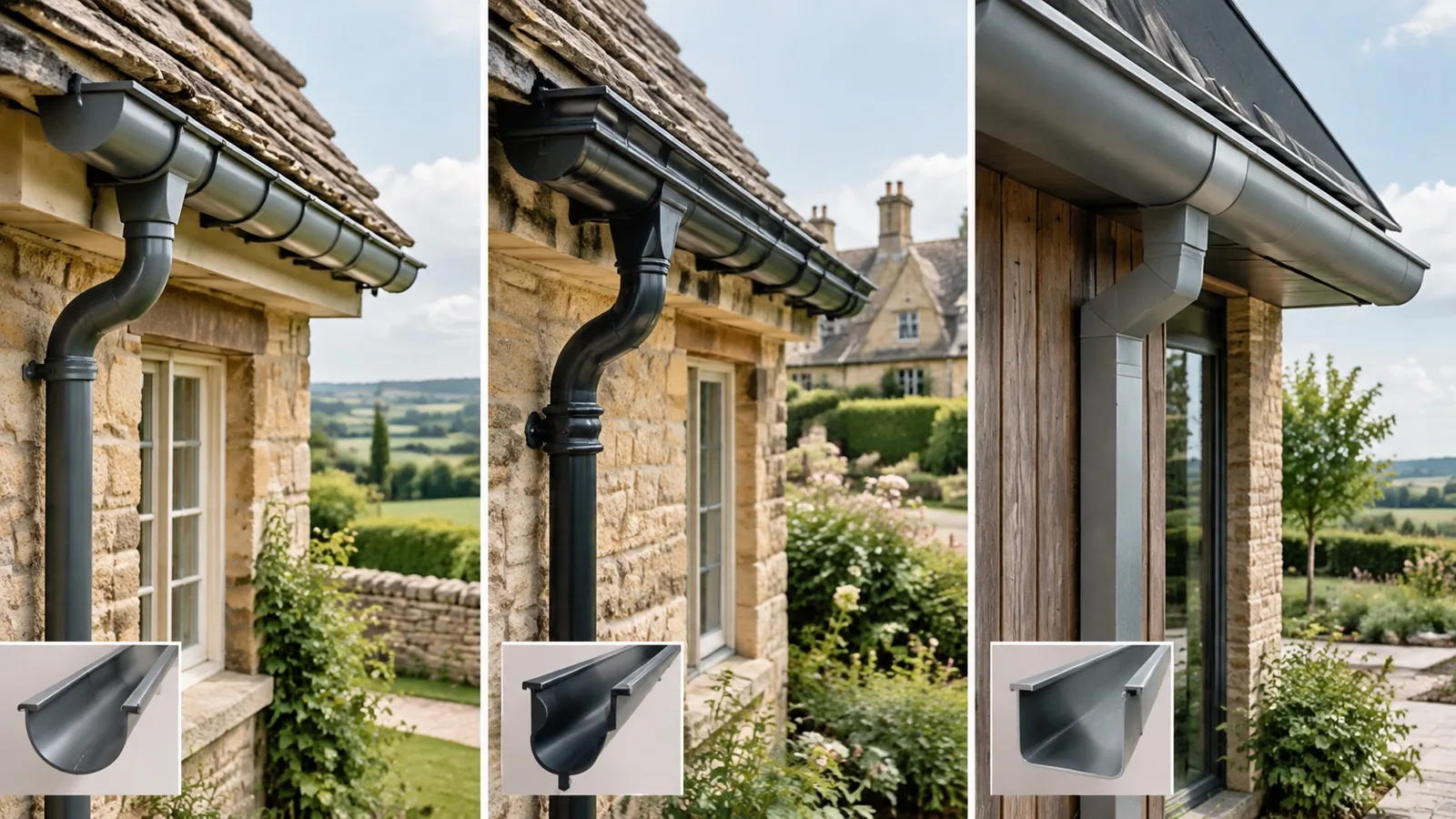
Beyond selecting colours and base materials, the gutter profile, which defines the cross-sectional shape of the trough, determines both the aesthetic presence and the hydraulic capacity of the installation. Three principal designs lead the market in both historical restorations and modern architectural projects: half-round, ogee, and deepflow. Each shape delivers distinct advantages in terms of water flow, debris management, structural capacity, and historical authenticity.
The Classic Half-Round: Timeless Simplicity
The half-round profile is precisely what its name implies: a clean, semi-circular trough. Its smooth, continuous curve presents an understated line that integrates naturally with a wide variety of architectural forms. From rustic farmhouses and quaint country cottages to minimalist modern buildings, its simplicity remains its greatest asset.
From an architectural perspective, half-round gutters provide a soft, unobtrusive boundary along the roofline. They do not compete with decorative timber fascias, intricate stonework, or delicate roof tiles, making them a natural choice for period properties where a modest, authentic appearance is desired. Historically fabricated from cast iron, this profile has protected British buildings for generations, harmonising with natural stone elevations and traditional brickwork.
Functionally, the semi-circular interior of the half-round gutter offers exceptional hydraulic efficiency. Because the base is completely rounded without sharp internal angles, rainwater flows rapidly and unobstructed towards the outlets. This smooth, circular water movement helps to prevent stagnant pools from forming during lighter showers. Furthermore, the absence of interior corners allows the trough to shed fallen leaves, silt, and moss far more easily than angular profiles. For homes surrounded by mature trees in the Berkshire countryside or rural Wiltshire, this self-clearing tendency reduces blockages and simplifies seasonal cleaning.
The Elegant Ogee: Heritage Charm and Grandeur
Named after the traditional architectural 'S' curve, the ogee profile features a sculpted, decorative face. Often referred to as 'K-style' in other parts of the world, the British ogee profile is defined by this distinctive, fluid shape. Having gained widespread popularity in the 18th century, ogee guttering remains a staple of Georgian, Victorian, and Edwardian architecture.
Unlike the understated half-round, the ogee gutter serves as a deliberate visual feature. Its stepped, ornate frontage casts subtle shadow lines that complement detailed brick eaves, elaborate cornices, and decorative fascias and soffits. On grand townhouses, substantial country manors, or Victorian villas, standard curved gutters can appear insubstantial. The pronounced, moulded profile of the ogee provides the visual weight and historical character required to match substantial architectural detailing.
Beyond its period elegance, the ogee profile delivers practical drainage benefits. Thanks to its squarer base and deeper vertical back edge, an ogee gutter often provides a greater water-carrying volume than a half-round gutter of equivalent nominal width. This expanded cross-sectional capacity allows it to manage heavier deluges effectively, channelling substantial torrents of water away from the roofline before overflow can occur. However, the internal contours that give ogee its distinctive profile can collect debris if gutters are neglected, meaning routine inspection is beneficial, particularly on heavily wooded plots.
Deepflow Gutters: Modern Engineering and Superior Capacity
Deepflow gutters represent a contemporary refinement of classic rainwater management. In basic geometry, deepflow systems resemble a half-round trough, but they are manufactured with a substantially increased depth, creating a distinctive, deep U-shaped channel. This engineering focus prioritises internal volume and high-performance drainage.
As rainfall intensity patterns continue to test traditional gutter installations, deepflow profiles have become an indispensable option for challenging roof designs. By significantly increasing the overall depth while retaining a manageable width, deepflow gutters dramatically increase total water-carrying capacity without looking clumsy or oversized. They are ideally suited to properties with extensive roof surface areas, steeply pitched roofs that shed water at high velocities, or homes situated in exposed locations across the rolling hills of Oxfordshire and Gloucestershire where driving storms are frequent.
Visually, deepflow gutters maintain clean, unembellished lines that make them an outstanding pairing for contemporary, minimalist architecture. They offer the quiet simplicity of the half-round profile, but their deeper proportions lend a reassuring look of strength and purpose. When paired with complementary fascias and soffits, deepflow systems deliver an efficient, modern roofline solution that handles high volumes of water without compromising external appearance.
Profile Comparison: Form, Function, and Water Flow
Choosing between half-round, ogee, and deepflow requires a careful balance of aesthetic intent, roof dimensions, and local weather exposure. While all three manage rainwater, their operational performance differs across several key areas:
- Architectural Suitability: Half-round is the most versatile, suitable for modest period cottages, farmhouses, and modern homes. Ogee is tailored for classical, ornate period properties such as Georgian, Victorian, and Edwardian buildings, or modern homes seeking historical grandeur. Deepflow caters to minimalist contemporary homes, large commercial structures, or substantial domestic roofs where functional capacity is the primary concern.
- Water Capacity: Ogee holds more water than a standard half-round of identical nominal width due to its squarer base. Deepflow offers the highest water-carrying volume of the three, specifically designed to capture and convey sudden, heavy downpours from expansive roofs.
- Debris Resistance: Half-round gutters shed leaves, silt, and organic matter with ease because their rounded bottom leaves no internal corners for material to lodge in. Deepflow channels also share this smooth curve, though their increased depth means accumulated material requires proper flushing. Ogee gutters have internal angles that can catch debris if not cleared periodically.
- Visual Prominence: Half-round gutters blend into the roofline with minimal distraction. Ogee creates a decorative, prominent architectural feature. Deepflow sits comfortably between the two, presenting a modern, functional profile without excessive ornamentation.
Material Matters: Pairing Profiles with Appropriate Substrates
While the profile governs the visual outline and water capacity of your guttering, the material dictates its operational lifespan, structural rigidity, and maintenance requirements. Austen Dawson works with a wide spectrum of materials, ensuring the selected profile performs properly within its architectural context.
Aluminium and Seamless Aluminium
Aluminium is lightweight, robust, and completely rust-proof, making it one of the most reliable materials for domestic and light commercial applications. Available in an extensive range of colours, it adapts readily to both heritage-style homes and modern buildings. A major development in aluminium rainwater management is the seamless aluminium system. Extruded on-site to the exact measurements of the property's eaves, seamless aluminium gutters eliminate intermediate joins across straight runs. Because joints are traditionally the primary origin of leaks, seamless aluminium profiles offer long-term reliability and an exceptionally clean, unbroken roofline.
Cast Iron
Cast iron remains the definitive choice for authentic heritage restoration, conservation areas, and listed properties. Offering an authentic historical appearance, exceptional structural strength, cast iron is historically accurate for both half-round and ogee profiles. Its substantial weight demands precise fixing into sound structural timbers, but the resulting finish preserves period architecture with complete integrity.
Cast Iron Effect
For homeowners who desire the classic styling of traditional cast iron without the associated weight or maintenance, cast iron effect systems provide a practical alternative. Fabricated from modern aluminium, cast iron effect systems replicate the textured surface, traditional brackets, and decorative detailing of historic ironwork. This provides an authentic heritage appearance while remaining cost-effective, lightweight, and easy to maintain.
Copper and Zinc
Copper and zinc represent premium choices for bespoke architectural and heritage rainwater systems. Both metals are naturally durable and exhibit exceptional longevity. Copper boasts self-healing properties, developing a rich, protective green patina over time as it reacts with the atmosphere. Zinc similarly weathers into a refined, protective matte finish. Both materials lend themselves to half-round, deepflow, and bespoke ogee profiles, providing unique character that improves with age.
Decorative Lead Hoppers
In bespoke heritage systems, gutters are frequently paired with decorative lead hoppers. Hoppers collect water from multiple roof channels or act as decorative transitions into downpipes. Often embossed with dates, motifs, or traditional geometric patterns, lead hoppers bring bespoke craftsmanship to period ogee and cast iron installations across the region.
Harmonising Profiles with Regional Property Styles
Throughout the Cotswolds, Gloucestershire, Oxfordshire, Wiltshire, and Berkshire, local vernacular architecture dictates how building elements should be specified. Rainwater goods must respect this context.
A limestone cottage in the Cotswolds, characterised by stone mullions, rustic timbers, and stone roof slates, calls for an understated profile. A traditional cast iron or cast iron effect half-round gutter fits quietly below the eaves, protecting soft mortar without creating an anachronistic distraction. Conversely, a tall Victorian townhouse in Gloucestershire or an elegant Georgian residence in Oxfordshire often demands the architectural authority of an ogee profile. The classical lines of ogee gutters pick up on intricate stone pediments, timber fascias, and decorative masonry, maintaining the balance intended by original builders.
For expansive modern builds or rural barn conversions with sweeping roof slopes in Berkshire or Wiltshire, deepflow gutters are frequently the most appropriate specification. In these contexts, standard half-round profiles may struggle to contain rainwater rushing down steep, broad expanses. Deepflow aluminium gutters provide the necessary hydraulic capacity while matching the sharp, clean lines of modern roof architecture.
The Role of Fascias, Soffits, and Professional Surveys
Gutter profiles do not operate in isolation; they form part of a unified roofline system alongside fascias and soffits. The condition of the fascia boards determines how securely a gutter profile can be bracketed and pitched. Heavy materials, such as genuine cast iron ogee profiles, require solid timber backing, while modern aluminium installations can be tailored to suit new, low-maintenance fascias.
Choosing the ideal profile requires an objective assessment of roof pitch, square meterage, local rainfall exposure, and architectural style. At Bespoke Guttering Solutions by Austen Dawson, projects range from everyday domestic aluminium jobs to complex, bespoke heritage rainwater systems. A professional survey identifies the exact water-carrying capacity your roof requires, matches the profile to your home's character, and ensures the guttering performs as it should.
Frequently Asked Questions
How does the capacity of an ogee gutter compare to a half-round profile?
An ogee gutter typically provides a greater water-carrying capacity than a standard half-round gutter of equivalent nominal size. This increased capacity is due to its internal geometry, which features a wider, squarer base and higher back edge. This allows ogee systems to collect and move a higher volume of rainwater, making them an effective choice for properties that require both period aesthetics and robust water handling.
Why are half-round gutters less prone to debris accumulation?
Half-round gutters feature a continuous, curved interior with no internal corners or right angles. As rainwater enters the channel, it naturally swirls through the lowest point, maintaining velocity and washing loose silt, moss, and leaves toward the downpipes. Because there are no flat ledges or sharp corners to trap falling debris, half-round systems are easier to clean and stay clear longer, especially near mature trees.
When is a deepflow gutter system recommended over a standard profile?
Deepflow profiles are recommended for properties with large roof surface areas, steeply pitched roofs, or homes situated in regions prone to heavy, driving rainfall. Because deepflow gutters possess a significantly deeper trough than standard half-round systems, they can capture fast-moving water without overflowing the front lip. They are also widely chosen for modern homes where owners desire clean, simple lines combined with exceptional drainage capacity.
What are the advantages of seamless aluminium gutter profiles?
Seamless aluminium gutters are extruded on-site directly from a mobile machine to the exact length of the property's roofline. This process eliminates joints and seams along straight runs. Because traditional gutter leaks almost always originate at failed seams, unions, or sealant joints, seamless aluminium provides a long-lasting, leak-resistant solution with a clean, unbroken appearance.
Can cast iron effect materials be used instead of authentic cast iron?
Yes. Cast iron effect systems, manufactured from high-quality aluminium, accurately replicate the traditional appearance, textured surface, and detailing of cast iron gutters. They offer an ideal alternative for period-style properties where owners want to avoid the significant weight and ongoing painting maintenance of genuine cast iron, while still achieving a traditional aesthetic.
To ensure your property is protected with the ideal gutter profile, request a free estimate.