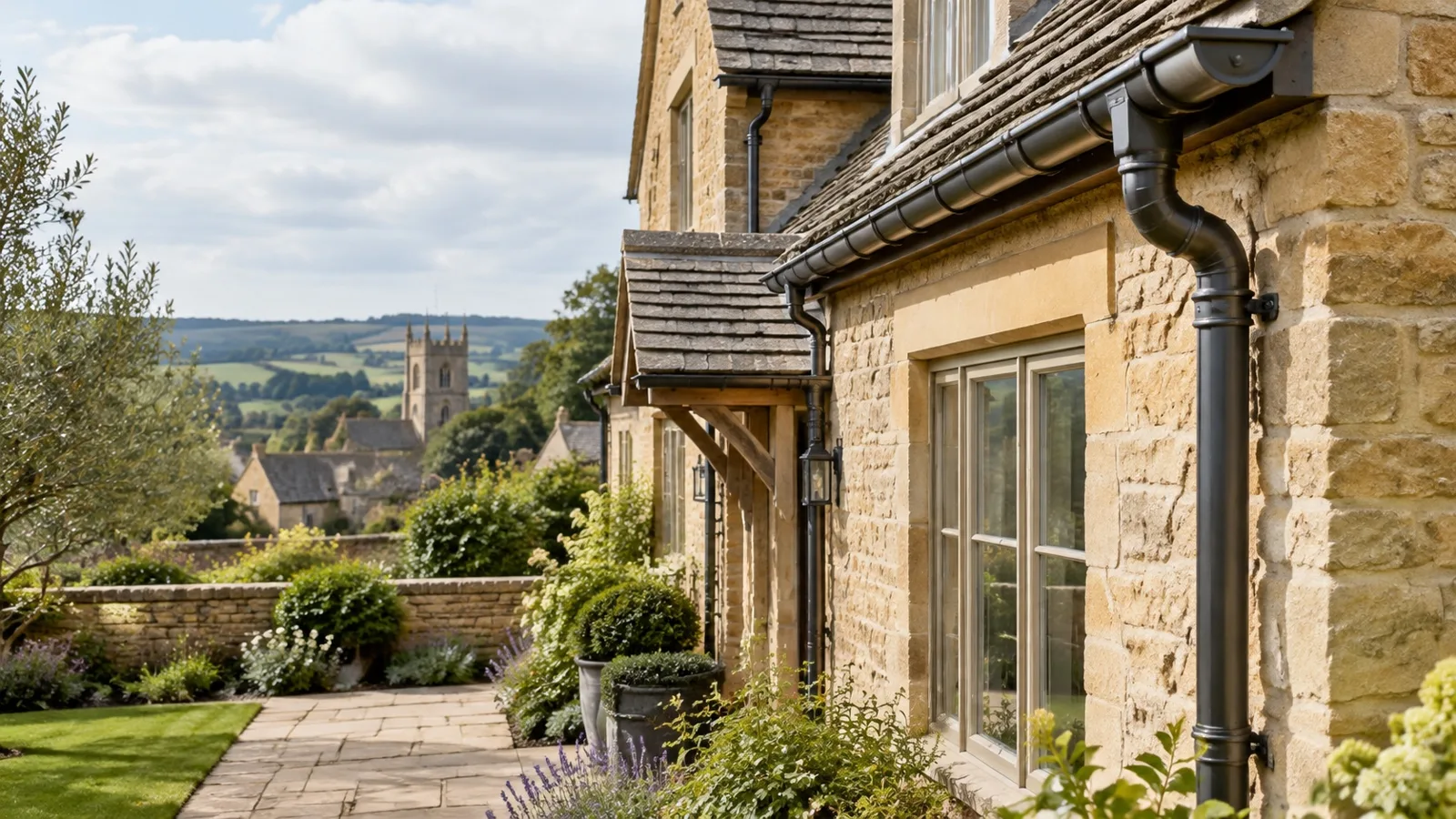
Few building materials capture the shifting light of the English countryside quite like Cotswold stone. From the pale, creamy tones of northern Gloucestershire to the warm, honeyed amber found across Oxfordshire and Wiltshire, this oolitic limestone gives our region its unmistakable identity. When paired with traditional stone slates or dark Welsh slate roofs, rainwater goods cease to be mere utilitarian plumbing. Instead, they act as architectural punctuation—framing the roofline and either flattering centuries-old masonry or jarring harshly against it.
Choosing guttering for these properties requires a sensitive eye. An ill-considered modern plastic system in brilliant gloss white or synthetic jet black will instantly cheapen the soft texture of a historic facade. Conversely, the right combination of profile, tone, and material brings out the subtle warmth of the stone, quietly protecting the fabric of the building while respecting its heritage.
The Palette: Harmonising with Natural Limestone
The golden rule when framing Cotswold stone is to avoid harsh, reflective finishes. High-gloss coatings bounce sunlight in a way that feels synthetic against porous, hand-dressed masonry.
Heritage black remains the timeless standard, especially in an authentic textured finish that mimics traditional painted metal. Yet it is by no means the only option. Deep graphite greys, muted slate tones, and rich earthy bronzes sit exceptionally well against weathered stone, picking out the deep shadows beneath the eaves.
Where timber fascias and soffits are finished in muted heritage shades—such as chalky stone greys or soft lichen greens—matching the guttering in a complementary architectural powder coat softens the roofline. This prevents a stark boundary between wall and roof, allowing the eye to appreciate the stonework uninterrupted.
Material Matters: From Cast Iron to Modern Metalwork
The architectural pedigree and listing status of your home will often guide the material specification, but modern fabrication offers superb solutions for historic renovations and contemporary village extensions alike.
Cast iron remains the benchmark for Grade II and Grade II* listed buildings. Its weight, tactile surface, and historical authenticity are irreplaceable on historic farmhouses, rectories, and manor houses. Decorative lead hoppers, cast iron downpipes, and traditional ornate rainwater heads serve as handsome architectural features in their own right, grounding the building in traditional craftsmanship.
For properties where the appearance of cast iron is desired without the long-term repainting requirements, cast iron effect aluminium has become an outstanding alternative. It faithfully replicates the textured surface, authentic pipe collars, and traditional brackets of heritage metal, while delivering the lightweight, rust-free durability of modern aluminium.
Similarly, extruded and seamless aluminium systems have established a vital place in regional architecture. With crisp, clean joints and exceptional weather resistance, seamless aluminium guttering is widely favoured for modern barn conversions and domestic renovations where visual clutter must be kept to an absolute minimum.
For those seeking something distinctive, natural metals such as zinc and copper offer a living, evolving finish. Left unlacquered, copper gradually transitions from a bright penny gleam into deep chestnut brown, before developing the soft verdigris patina that looks breath-taking against pale Cotswold stone.
Profiles and Proportion: Finding the Right Balance
Because Cotswold roofs are often steeply pitched and clad in heavy stone or slate tiles, rainwater discharges with considerable velocity during heavy cloudbursts. Gutter profiles must therefore balance adequate capacity with proportionate visual depth.
- Half-Round: The understated classic. Its curved, gentle profile tucks neatly under the eaves without dominating the facade, making it the most sympathetic choice for modest vernacular cottages.
- Deep-Flow Half-Round: Ideal for expansive rooflines where extra water-carrying volume is essential, offering high capacity without resorting to oversized industrial dimensions.
- Moulded Ogee: A decorative, fluted profile reflecting classical eighteenth- and nineteenth-century design. Ogee profiles lend a tailored, cornice-like finish that suits Georgian townhouses, substantial farmhouses, and Victorian villas.
- Beaded Half-Round: Featuring an outward-curled decorative bead along the front rim, this profile offers subtle shadow lines reminiscent of historic lead and zinc installations.
Where rafters are exposed or stone corbels carry the eaves without modern fascias, using traditional rise-and-fall drive brackets fixed directly into the masonry preserves the historic overhang and avoids awkward timber fixings.
Heritage Sympathy Meets Everyday Practicality
Every home demands its own considered approach. At Bespoke Guttering Solutions by Austen Dawson, our work bridges the gap between specialist preservation and reliable modern installation. On any given week, our team might be installing bespoke heritage rainwater systems with ornate hoppers on an Oxfordshire country house, alongside durable, efficient domestic aluminium guttering for family homes across Gloucestershire and Wiltshire.
Whether you are managing a comprehensive heritage restoration, replacing tired plastic with cast iron effect metal, or updating an everyday domestic property with high-performance seamless aluminium, the aim remains the same: safeguarding your home against the elements with guttering that naturally belongs.
If you would like to explore the colours, profiles, and materials best suited to your property, we would be delighted to visit your home to provide a considered assessment and arrange a no-obligation survey.