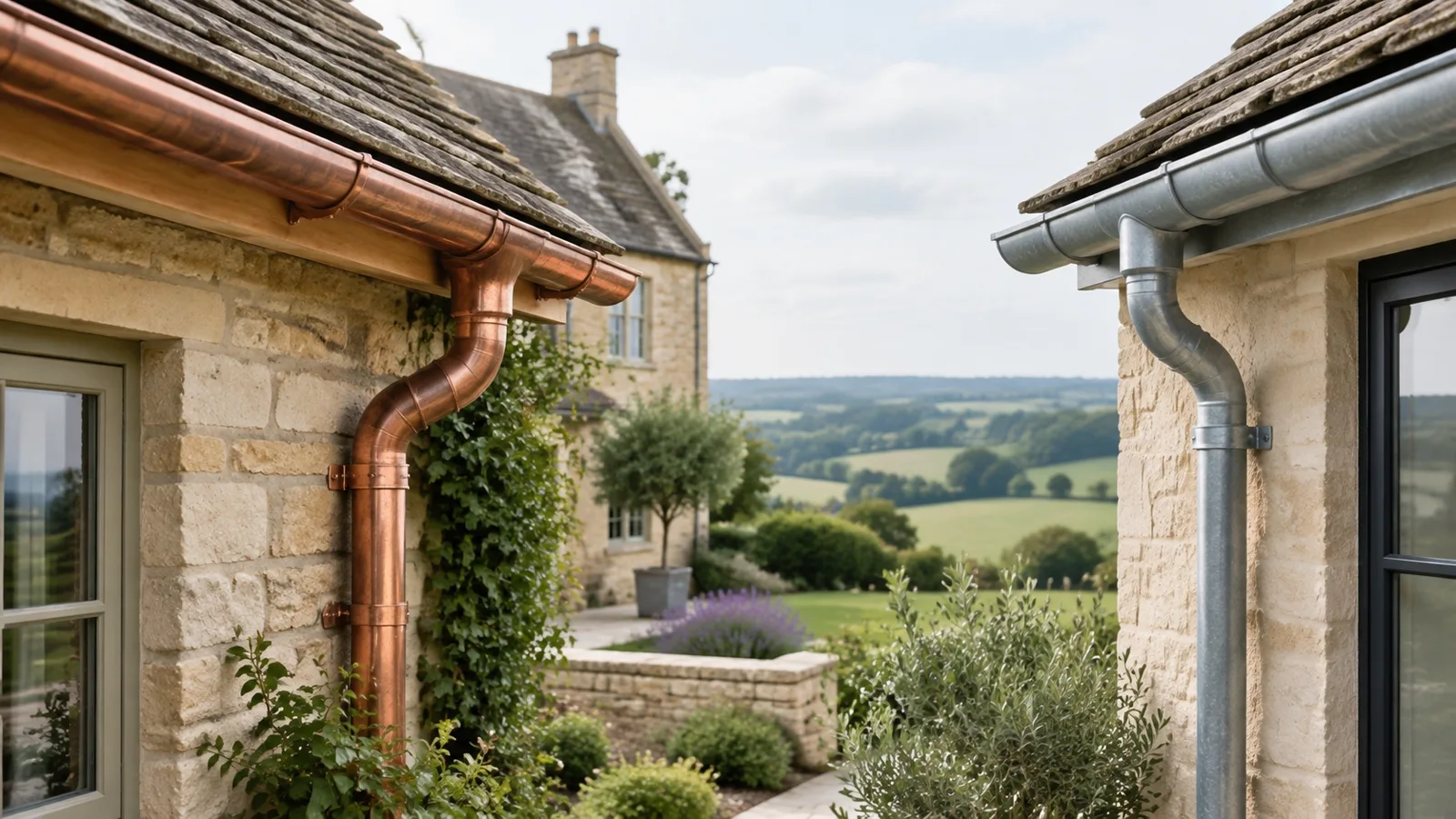
There was a time when rainwater goods were treated as an afterthought—utilitarian fixtures pinned to the eaves simply to keep the weather off the masonry. Yet on architect-led renovations, barn conversions, and contemporary new-builds, gutters and downpipes have rightly reclaimed their place as defining architectural details. Like crisp joinery or thoughtful stonework, the right profile frames a house, grounding its elevations and catching the light.
For those commissioning high-specification homes across the Cotswolds and the home counties, the debate almost inevitably settles on two remarkable non-ferrous metals: copper and zinc. Both elevate a roofline well beyond standard powder-coated finishes, yet they age, perform, and sit against natural materials in very distinct ways.
The Living Finish: How Copper and Zinc Mature
The primary joy of both metals lies in their refusal to remain static. Unlike painted finishes that merely degrade under ultraviolet light, copper and zinc interact continuously with the elements, developing protective self-healing patinas that shield the substrate beneath from corrosion.
Copper enters the world with a bright, gleaming penny shine. Within a few wet weeks in the English landscape, oxidation begins, softening the mirror-like sheen to a rich, warm russet brown. Over subsequent decades, atmospheric moisture slowly converts this layer into the fabled pale-green verdigris often admired on historic churches. In clean rural air, this transformation is gentle and slow; in urban or coastal environments, it accelerates. It is a material with historic gravity, pairing effortlessly with reclaimed clay tiles or weathered oak.
Zinc, by contrast, takes a quieter, more architectural route. In its natural pre-weathered state, it displays a velvety, chalky grey hue that weathers into an understated matte patina. For crisp modern elevations—think charred timber cladding, pale render, or vast floor-to-ceiling glazing—zinc offers clean Scandinavian minimalism without looking industrial. Where copper is an overt statement, zinc is an exercise in subtle restraint.
Lifetime Value and the True Cost of Ownership
There is no skirting the issue: commissioning a bespoke copper or zinc installation requires a significant initial investment. The raw materials command high commodity prices, and they demand specialist tradespeople who understand thermal expansion, solder integrity, and delicate mechanical jointing.
However, evaluated across the lifetime of a home, the economics shift dramatically. Where conventional plastic fails within fifteen years and lower-grade metals require frequent repainting, zinc routinely delivers a maintenance-free lifespan of 70 to 100 years. Copper can comfortably exceed a century, outliving fascias, soffits, and frequently the roof coverings themselves.
When we advise clients weighing up lifetime costs, we often consider their broader building envelope:
- Maintenance demands: Neither metal requires regular re-coating or rust-inhibiting treatments, unlike historic cast iron.
- Run-off and staining: Unstabilised run-off from fresh copper can temporarily stain pale render or porous paving below; zinc is far gentler on adjacent finishes.
- Recyclability: Both metals are infinitely recyclable, retaining scrap value and boasting exceptionally low embodied energy over their working life.
- Structural stability: High thermal resistance prevents cracking through deep freeze-thaw cycles, a common point of failure for lesser profiles.
Architectural Context: Selecting for Stone and Setting
Geography and architectural context invariably dictate which metal feels native to a property. Across Gloucestershire and Oxfordshire, where golden limestone predominates, copper feels innately sympathetic. Its initial chestnut hues echo the ironstone veins in the quarries, while the mature patina provides an exquisite counterpoint to warm stone mullions. It is equally at home alongside handmade lead hoppers on Grade II listed restorations.
Move further south into Wiltshire or the open downs of Berkshire, where flint, dark slate, and zinc-clad extensions emerge on striking contemporary dwellings, and pre-weathered quartz zinc suddenly steals the show. Zinc’s cool blue-grey spectrum harmonises with local flints and dark engineering bricks, lending sharp lines to modern standing-seam roofs.
Context matters profoundly. A gleaming copper hopper can look gaudy if badly detailed, just as standard zinc can look sterile on a 17th-century thatched cottage. The secret lies in the profiling—half-round or box profiles, hand-cast brackets, and seamless corner details designed specifically for the building's scale.
Balancing Ambition with Practical Installation
While our workshop is renowned for shaping these bespoke heritage rainwater systems, we believe good drainage engineering belongs on every roof. We apply the same meticulous eye for falls and bracket spacing whether we are forming rolled copper half-rounds for an estate farmhouse or fitting seamless aluminium guttering on an everyday domestic extension.
Choosing between copper and zinc is rarely about which material is technically superior; both will likely outlast our own lifetimes. Rather, it is about deciding how you want your home to age, how light should play across your eaves, and what legacy of craftsmanship you wish to leave behind.
If you are planning an architectural build, a major renovation, or an extension and would like to explore what these enduring metals could bring to your property, get in touch with our team to arrange an on-site survey.